Search for active hashtags
All Records (784230) Open monitored list of hashtags
MusiqueNow (@MusiqueNow@todon.eu)
Names of innocent Iranians targeted for execution
(Please reboost! It's important!)
#MohammadQabadlon
#SamanSeydi
#SoheilKhoshdeh
#MohsenRezazadeh
#SaeedShirazi
#MohammedBeroghani
#AbolfazlMehriHosseinHajilou
#ManiuchehrMehmannavaz
#AbbasDaris
(Source: https://www.tiktok.com/@littleyeg #TikTok, #UrgentIranNews)
Show Original Post
michael (@michael@mstdn.thms.uk)
After turning up here a couple of weeks or so ago, I figured it's time for an #introduction
I'm a full stack web developer, currently working mostly with #php (#laravel) and Vanilla #javascript and #scss. Still love #cfml too.
Outside of that, my main interests are around #infosec, #fintech, and just learning new stuff.
Husband, father of 2 boys, speaker of #German and #english with some basic understanding of #Arabic
Started running my own instance just for fun, and loving it. #mastoadmin
Show Original Post
mlanger (@mlanger@mastodon.world)
I’m a #polymath who gets her kicks learning and doing new things.
I started in corporate finance, then went freelance as a #writer, #author of #tech #books, articles, and #video training material. Along the way, I learned to fly #helicopters and bought one. I launched my own helicopter charter business and a popular #YouTube channel of #flying videos. Now I’m mostly #retired, a #jewelry #artist and #boat #captain, #RVing and #boating with my pups when I’m away from home.
Show Original Post
stefan (@stefan@social.stefanberger.net)
I guess I missed doing a short #introduction 😂
I’m a dad of a little son living in #Kerken, Germany 🇩🇪. As an engineer at the International IT of ALDI South I’m helping a lot of teams with automation, CI/CD etc. In former roles I worked as Cloud Solution Architect (#AWS) and #smalltalk developer/SA.
Besides #exploring the world with my family, I like creating stuff with computers, doing #selfhosting, #virtualization using #proxmox, #docker etc.
Currently I’m deeply into #mastodon 🎉
Show Original Post
JosephLeedy (@JosephLeedy@phpc.social)
I guess it’s my turn for an #introduction. 👋🏽
My name is Joseph, or Seph for short (please don’t call me Joe). I’ve been doing Web development as a hobby since 1999, #PHP since 2002, and I’ve been a professional #Magento developer since 2011.
In my free time, I can be found either watching #motorsports or riding my #motorcycle. I also love to #travel, and I try to take a trip to Europe once a year. So far I’ve visited Austria, Belgium, England, Germany, Italy, Netherlands, Scotland, and Wales.
Show Original Post
nettoyer-les-tweets-de-son-compte-twitter (@nettoyer-les-tweets-de-son-compte-twitter@www.simounet.net)
Nettoyer les tweets de son compte Twitter
https://www.simounet.net/nettoyer-les-tweets-de-son-compte-twitter/
Show Original Post
szhang_ds (@szhang_ds@ioc.exchange)
India requires several threads to go through. I found five networks of fake accounts ("IT cells") across the political spectrum - 2 pro-BJP, 2 pro-INC, 1 pro-AAP.
As a large, populous, and important country, India was high-pri at FB. The company agreed pretty quickly to take them down.
They took out 4/5. We found the 5th IT cell was ran by MP Vinod Sonkar (BJP - Kaushambi), the LS Chair of Ethics; the company went silent and refused to act (5/?)
#india #socialmedia #bjp #aap #inc #facebook

Show Original Post
szhang_ds (@szhang_ds@ioc.exchange)
If you want to read more about my work:
In Honduras: https://www.theguardian.com/technology/2021/apr/13/facebook-honduras-juan-orlando-hernandez-fake-engagement
In Azerbaijan: https://www.theguardian.com/technology/2021/apr/13/facebook-azerbaijan-ilham-aliyev
In India: I recommend https://caravanmagazine.in/media/sophie-zhang-interview-facebook-inauthentic-networks-democracy (should have no paywall inside India.)
In the U.S., my own work contributions were minor, but I was the one who raised it when a right-wing marketing firm ran ads for left-wing political parties, didn't file paperwork, and someone unrelated told the FEC they were responsible: https://www.theguardian.com/technology/2021/jun/11/facebook-ads-turning-point-usa-rally-forge
(2/?)
Show Original Post
szhang_ds (@szhang_ds@ioc.exchange)
If you've just started following me and want to know more:
I worked at FB from 2018-2020 before turning whistleblower in early 2021 (linking the initial guardian piece.)
Everything you've read about my work on fake accounts in the press wasn't part of my official job; I moonlighted in it in my spare time. This included catching the governments of Honduras/Azerbaijan running troll farms/IT cells, and the work I did in the U.S./India. (1/?)
Show Original Post
trmsc (@trmsc@bildung.social)
@teacherrogueone Überwältigt und inspiriert von diesem gigantischen #gamification -Thread (vielen Dank @teacherrogueone ! 😍 ), habe ich in der Mittagspause ein kleines Addon für die #moodle -Lernlandkarte von @stefanhanauska , @PhilippMemmel et. al. gebaut. 😚
Die Symbole können in der Anzahl und Auswahl frei aus der #FontAwesome Bibliothek zusammengestellt und mit Punkten pro Ort versehen werden. ⭐
#opensource #code mit Mini-Doku zur Einbindung in den #Attoeditor 👇

Show Original Post
muiiio (@muiiio@mst.muiiio.com)
I feel #Mastodon merits a vocabulary shift, given its design's contraposition to Twitter...
How about:
Accounts/Users = #People
Content = #Conversation
Engagement = #Connection
Consumption = #Communication
Show Original Post
andypiper (@andypiper@macaw.social)
#Introductions (more of a re-intro, ~5 yrs Mastodon veteran on the original instance)
I’m Andy, a techie, developer advocate, educator and public speaker based in the UK. Follow me for rambling about, among other things…
- #MicroPython
- #APIs
- #MQTT
- #OpenSource
- #VideoGames (Xbox/Switch/Steam Deck/indie)
- #LEGO
- #BoardGames
- #DrWho
- #PenPlotter
- Online communities
- Home automation
- blinky things / making
Links and more -> https://andypiper.me
Show Original Post
casraf (@casraf@fosstodon.org)
I guess it's time for an #introduction.
I'm a freelance full-stack & mobile developer at trade and love playing with different techs in my free time.
Love problem-solving, finding ways to introduce creativity into code, and creating quality-of-life dev tools and libraries whenever I can.
I have some packages for #javascript and #dart and other nice stuff on my website at https://casraf.dev/projects :) feel free to say hi!
#javascript #typescript #react #flutter #dart
Show Original Post
cirriustech (@cirriustech@infosec.exchange)
Introduction
Redoing my #introduction as it was a bit of a sparse one when I joined.
I am a lifelong #technology enthusiast, having worked in Financial Services IT for more than 25 years, across multiple disciplines including:
* #Unisys #MCP-based #mainframe platforms (A17/A19/HMP NX 6800/Libra 180/Libra 6xx/Libra 890)
* #EMC #Symmetrix storage arrays (DMX 3/4 and most recently VMAX) including experience of #SRDF(S), SRDF(A), BCV
* #WindowsServer (2000 through 2019) including #ActiveDirectory
* Various #Linux/ #Unix OSes (#HPUX/ #RHEL/ #Centos/ #Ubuntu/ #Raspbian) including experience of #GFS/#GFS2 SAN storage clustering
* Virtual Tape Server technology (B&L/Crossroads/ETI Net SPHiNX, #TSM)
* Automation/Scripting (#PowerShell, #NT #Batch, #DOS, #Bash, #OPAL)
* #Security (#PrivilegedAccessManagement, #LeastPrivilege, #IAM, #Firewalls, #EDR)
* #BusinessContinuity/#DisasterRecovery (Design/Implementation/Operations)
I’m focused on learning and getting hands-on with #RaspberryPi at home and #cloud computing solutions both at work and at home.
I moved into a #SecurityEngineering role in 2020, so a lot of my focus is now more security focussed across all tech stacks.
My main focus at present when it comes to cloud is predominately #Microsoft #Azure, with Google and AWS of interest also, as well as other cloud infrastructure services such as those provided by CloudFlare, though I’m planning a move away from them due to their moral/ethical choices.
Away from work and tech, I love to #travel the world with my wife and enjoy very amateur #photography to record our adventures.
I also love most genres of #music, live in concert when I can, with a particular love of #Rock/ #Metal and also #Trance (coincidentally, given the profession of a somewhat more well known namesake of mine!).
Show Original Post
trmsc (@trmsc@bildung.social)
Etwas verspätet aber da ich immernoch #neuhier bin, stelle ich mich noch vor:
Als #sopaed #Lehrkraft - #GMS #Inklusion #eduBW #FediLZ - ist es mein Ziel, Räume, Situationen, Materialien zu entwickeln, die #opensource #OER und #barrierefrei sind und möglichst viele, individuelle Wege eröffnen. 🤝
Die Prozesse dorthin dürfen aber gerne "verspielt" sein und in die Tiefe gehen - insbesonere in meinen 🧡-Bereichen #moodle #coding #dev #Javascript #JS #CSS #webdesign .
Ich freue mich auf euch! 🙌

Show Original Post
lutz_ (@lutz_@bildung.social)
Für alle, die #neuhier sind und sich gerne mit den wichtigsten Funktionen der Oberfläche von #Mastodon vertraut machen wollen, sei das tolle Online-Tutorial "Klickschulung für Mastodon" von @ebildungslabor empfohlen.
Einfach der Reihe nach auf die Fragezeichen klicken und die kurzen Erklärvideos anschauen. Es lohnt sich!
https://ebildungslabor.de/blog/klickschulung-fuer-mastodon/
Show Original Post
speckledband (@speckledband@ravenation.club)
Hello everyone, we are Speckled Band, new to Mastodon! Check out our #website www.speckled.band and give us a #follow here and if you can on #Spotify and #TikTok. We recently released the #EP Screaming Skull - available on all major #streaming platforms - and our new #single Peter Cook, in honour of the late satirist and comedian, is out this Thursday, November 17th. Our music is indie/pop #Beatles #Suede #Pulp #Blur and Scott Walker are big influences! #music #songwriting #newmusic #comedy
Show Original Post
Horaz (@Horaz@muenchen.social)
Ich hole mal meinen #neuhier-Tröt nach, ich bin nämlich seit geraumer Zeit #neuhier. Und überhaupt in Social Media, weil ich meine Gedanken, Fotos und Freundschaften nicht in die Hände von Firmen geben wollte, die damit Geld verdienen.
Ich war also nie bei #Twitter, #StudiVZ, #Lokalisten, #Facebook, #Instagram, #WhatsApp usw.
Das Spektakel nach der Übernahme von #Twitter durch diesen Psychopathen #Musk gibt mir irgendwie Recht, finde ich.
Show Original Post
lutz_ (@lutz_@bildung.social)
Für fachbezogene Beiträge #Hashtags benutzen:
sprachlich - künstlerisch - sportlich:
#deutschEdu
#englischEdu
#franzoesischEdu
#musikEdu
#kunstEdu
#sportEdu
NWT / MINT:
#biologieEdu
#chemieEdu
#informatikEdu
#mathematikEdu
#physikEdu
Gesellschaftswissenschaften:
#erdkundeEdu / #geographieEdu
#geschichteEdu
#sowiEdu
#wipoEdu
#religionEdu
Posts die die #fachEdu-Tags oder #fediLZ + #unterrichtsfach oder #schule + #unterrichtsfach) enthalten werden geboostet...
Show Original Post
amyfou (@amyfou@lingo.lol)
Content warning:#introduction
I am a #linguist (non-tenure track, uni) interested in every single thing about #languages, esp #Indigenous ones, #academics & #teaching Side gig in #ComunityBased #LanguageTech (#webdev #React #postgres #hasura #graphQL #nodeJS #nginx #linux #podman #kubernetes #docker #unicode lol). I love #animals and will ask you too many questions about your #dogs #cats #horses #sheep #goats #chickens #bunnies #piggies #cows etc . Proud #UglyDogs fan. Love #nature #birds #photography #art 👋
Show Original Post
eitch (@eitch@mstdn.gsi.li)
So i guess an #introduction is the thing to do. I'm a software developer with heavy focus on Java, i work at https://atexxi.ch which i co-founded, using https://strolch.li on a #RaspberryPi to communicate with our servers to try and lessen nurses burden on drug logistics.
I've been using Linux as my daily driver for over a decade, do some gaming, and love setting up infrastructure like #docker #Mastodon #Proxmox #gitea etc.
Show Original Post
2022 (@2022@jakespurlock.com)
RT @DocPop: Any #WordPress devs…
#WordPress #ImportFromTwitterAny #WordPress devs doing interesting stuff with ActivityPub/fediverse? Something like a WP>Mastodon plugin for example. If so, I'd love to chat with you for a @TheTorqueMag podcast next week.
— Doctor Popular (@DocPop) November 9, 2022
Show Original Post
nicemicro (@nicemicro@fosstodon.org)
I realize, that while I've been on this platform for a while, I haven't introduced myself, so here it goes.
I'm Nice Micro, scientist (semiconducting materials and semiconductor devices) by day, free software enthusiast, #bash script kiddie, #python wrangler, #Godot waiter and avid gym goer by whatever part of the day I'm not working.
I'm on YouTube with #Linux, #programming and gaming content.


 🎥
🎥
Show Original Post
Ryan (@Ryan@mstdn.ca)
I'm Ryan. #Tech person, mostly #Drupal #webdev with an occasional side of #Microsoft365.
Christian, of the #Anabaptist with #LiberationTheology variety, and involved with a local #Mennonite church.
I talk politics/social issues, local/Ontario/Canadian and to some degree US.
Home is in Kitchener, Ontario, Canada, part of the Haldimand Tract. #kwawesome #WatReg
First choice for transportation is my bike, followed by walking or taking the bus.
My cat is extremely cute and I post photos of her mostly on @Ryan@pixelfed.ca.
I watch lots of movies and TV and share mini reviews mostly as ryanlr on Letterboxd.
Show Original Post
dgoosens (@dgoosens@phpc.social)
hello!
late #introduction
I'm Dmitri, Belgian #php dev for about 20 years
Since 4 years very in love with #DDD which was a real revelation to me...
The missing link between Business, Architecture and Code
I prefer backend work (really don't enjoy frontend)
Work a lot with #symfony and very fond of @ApiPlatform which is, to me, the perfect stack to express my art/code.
also:
- #podcast addict
- #OSS enthusiast
- [belgian] beer lover
- drink too much coffee
- love walking in nature
Show Original Post
lucp (@lucp@toot.re)
Okay, as an overdue #introduction I'm Luc (he/him), a #developer from the Netherlands with a passion for #opensource. I work a lot with #php and #javascript.
When I'm not working I'm usually running a game of #dnd or caring for my #autistic special-needs kid :)
Show Original Post
simon (@simon@social.sgawolf.com)
Adding to the #introduction posts…
I co-own https://mindme.care (we provide GPS devices for #AssistedLiving) but I’m really a software developer who’s current love is #elixir but I also tinker with #python too.
I live in the #uk, detest #brexit and am getting more and more left-wing as I get older.
I’m interested in #ActiveTravel, #CargoBikes and #LivableCities (despite living in a small village in the countryside) and would one day love to build a sustainable, eco-home.
Show Original Post
AgatheBleibtDaheim (@AgatheBleibtDaheim@dizl.de)
Auf #twitter angefangen, aus Gründen bei 🐘 gestern eingezogen.
Habe einige meiner Mutuals gefunden & mitnehmen können & dürfen!
Für #KeinenMillimeterNachRechts & gegen #Quergida & #Querorristen.
Bei mir gilt #CovidIsNotOver, #DieMaskeBleibtAuf😷 bei mir, #impfenschützt
Bislang ohne #Covid19 geschafft. #TeamWissenschaft
#KeinePlattform für #Rassismus, #Misogynie, #Antisemitismus, #antiziganismus, #Transfeindlichkeit o.ä. Haltungen!
🇬🇧 English welcome!
🇩🇰 Dansk er velkommen!
Show Original Post
BiSasquatch (@BiSasquatch@c.im)
#introduction / #hellomastodon
I am Bi man from the Seattle area and #TwitterRefugee hoping to explore many of my interests here on Mastodon. For the near future I am just going to lurk and learn while I RTFM so I can learn to use Mastodon as well as see how the culture develops.
The reason I state I am Bi man at the beginning of this post is to help raise awareness of the #Bisexual community which is often misrepresented in the media and news. Obviously #Bisexuality and #LGBTQ issues and news are interests I will follow and contribute to here on Mastodon.
Other interests include:
#robotics #IoT, #Python #AI
#retrocomputing #PCgaming
#augmentedreality #virtualreality
#meditation #sleepdisorders #stressmanagement #ASMR
#cannabis #medicalmarijuana #psilocybin #accessibility #disability #ageism #sciencefiction #cats #crows #weather #astronomy #spaceexploration #oceanography #climatechange #teraforming #greenenergy
That's a long and rambling list, and I am sure there is more, but that's the best I can come up with for now.
This is my longest post for now, and I just used my first 1000 characters. Now that's something to toot about and not tweet about.

Show Original Post
ahoernchen (@ahoernchen@nrw.social)
Ich lese oft, dass man als #neuhier seine Interessen aufschreiben soll. 😮
Ich habe eigentlich keine. Ich weiß nur, was ich hier NICHT will. #Querdeppen #Nazis #Ausrastende #Beleidigende #Politikdiskussionen #Belehrungen
Ich finde es einfach toll, mit Fremden zwanglos zu kommunizieren, gemeinsam Spaß zu haben, sich zu wertschätzen und einander zuzuhören. 😊 Ab und an ein wenig Necken darf auch vorkommen. 😉
Die Welt ist momentan bekloppt genug. Da will man sich hier nicht auch noch ärgern. 😘
Show Original Post
mrbruno (@mrbruno@mstdn.social)
I suppose I'll introduce myself too.
Born in 1962 in rural southwest NYS, studied computer science in college, worked 1984-2009 for a big company, came to #RTP NC in 1997. I've been doing contract work lately and these days am deep into #Python, #Docker, #Ansible, #Packer, #Linux, #Jenkins, etc in what's essentially a long-term contract.
Outside work, I love music/concerts (#prog, #indierock, etc), some tv/movies, #cats, #kayaking (calm lakes), #puzzles.
Show Original Post
callekhan (@callekhan@hessen.social)
#NeuHier 👋
#TYPO3 #Linux #Hessen #Kassel #bikeporn #Rohloff #Speedhub #MdRzA #Autokorrektur #foodporn #Squash #RimWorld #Minecraft #Valheim #Rust
Show Original Post
2022 (@2022@blog.clickomania.ch)
Wie dumm kann man sein? Elon Musk: «Ja!»
Beitragsbild: Elon Musk Dreaming of a Brighter Future (Steve Jurvetson/Flickr.com, CC BY 2.0).
Seit einer Woche ist die Twitter-Übernahme durch und der neue Chef führt sich auf wie die sprichwörtliche Axt im Wald. Das war angesichts der Vorgeschichte nicht anders zu erwarten, aber dennoch finde ich es verblüffend, dass Musk grad gar keinen Zweifel daran lässt, dass er ein Chef ist, wie man sich in seinen düstersten Träumen nicht wünscht: Öffentlich zu verkünden, dass Leute gefeuert werden, die eine (sehr knappe) Deadline nicht einhalten, ist ein starkes Stück.
Bei «The Verge» werden die Umstände so geschildert:
Twitter plant derzeit, dass das neue Twitter Blue-Abonnement 20 US-Dollar kosten soll. Gemäss dem aktuellen Stand der Dinge hätten verifizierte Nutzer neunzig Tage Zeit, um das Abo abzuschliessen oder ihr blaues Häkchen zu verlieren. Den Mitarbeitern, die an dem Projekt arbeiten, wurde am Sonntag mitgeteilt, dass diese Neuerung bis zum 7. November stehen müsse, ansonsten sie entlassen würden.
Auch viele Twitter-Nutzer sind sauer
Und damit sind wir beim zweiten Punkt: Musk hat es geschafft, mit dieser Änderung auch viele Twitter-Nutzer gegen sich aufzubringen. Einer der prominentesten Kritiker der Idee ist Stephen King, der sich die zwanzig Dollar wahrlich leisten könnte: Er schrieb: «Scheiss drauf, die sollen mich bezahlen. Wenn das eingeführt wird, bin ich weg wie Enron.»
Die Antwort von Musk darauf war in etwa das Dümmste, was man Stephen King hätte entgegnen können: «Wir müssen die Rechnungen zahlen. Wie wärs mit acht Dollar?»
Nein, dumm ist das falsche Wort: Entlarvend. Diese Entgegnung zeigt, dass Musk etwas Grundsätzliches nicht verstanden hat: Er hält das blaue Häkchen für ein Statussymbol. Das ist es für manche vielleicht, aber im Kern geht es darum, dass das Häkchen Sicherheit bieten soll, weil es bestätigt, dass wir es mit der echten Person und nicht mit einem Hochstapler zu tun haben. Falls Musk Twitter tatsächlich «warm und einladend für alle» sein soll, dann muss er die Verifizierung nicht zu einem Bezahl-Feature machen, sondern kostenlos massiv ausweiten.
Elon braucht Geld
Natürlich geht es darum, dass sich Musk bei seiner Übernahme massiv verschuldet hat und jetzt neue Geldquellen erschliessen muss, damit er überhaupt mit einer schwarzen Null aus der Sache herauskommt. Es ist wiederum Stephen King, der das glasklar auf den Punkt bringt:
Musk lässt mich an Tom Sawyer denken, der zur Strafe einen Zaun streichen muss. Tom überredet seine Freunde, die Arbeit für ihn zu erledigen, und lässt sie für dieses Privileg bezahlen. Das ist es, was Musk mit Twitter machen will. Nein, nein, nein.
Musk makes me think of Tom Sawyer, who is given the job of whitewashing a fence as punishment. Tom cons his friends into doing the chore for him, and getting them to pay for the privilege. That’s what Musk wants to do with Twitter. No, no, no.
— Stephen King (@StephenKing) November 3, 2022
An dieser Stelle tut sich ein zweiter Schauplatz auf: Mastodon. Das ist diese Twitter-Alternative, die es seit Jahren gibt. Ich habe sie vor vier Jahren hier im Blog vorgestellt, sie dann selbst aber nicht mehr gross benutzt. Doch im Mai, als die Querelen um Musk und Twitter losgingen, war sie plötzlich wieder im Gespräch – und nicht nur das: Es kam auch tatsächlich Leben auf die Plattform.
Allerdings ebbte dieser Enthusiasmus wieder ab, während die Übernahme in der Schwebe hing. Doch jetzt scheint es, als ob Musk ihr einen weiteren – und vielleicht den entscheidenden – Schub verpasst. Denn die Wachstumsrate, die ich seit gestern gesehen habe, ist eindrücklich.
[caption id=“attachment_25153″ align=“aligncenter“ width=“1493″] Endlich macht mastodonisieren Spass![/caption]
Zwei neue Mastodon-Instanzen für die Schweiz
Ein wesentlicher Faktor ist die neue Instanz swiss-talk.net, die es seit gestern gibt. Für die hat der umtriebige Reda el Arbi (Das grosse Twitterer-Assessment, Folge 1: @redder66) auf Twitter Wind gemacht, und ihr zu einem guten Start verholfen.
Ich bin gespannt, ob der Elan anhält. Entscheidend wird sein, ob Elon weiterhin als wirkmächtiger, wenn auch unabsichtlicher Förderer von Mastodon auftritt. Ich habe mir jedenfalls erlaubt, meine Einstiegshilfe zu Mastodon mit einem Hinweis auf swiss-talk.net zu ergänzen – und auch auf swiss.social.
Spannend wird auch sein zu sehen, wie nachhaltig Musk dieses ganze Theater schadet. Mir scheint, der Ruf des genialen Entrepreneurs ist damit jetzt endgültig dahin.
#ElonMusk #FediversumUndMastodon #SozialeMedien #Twitter #Wochenkommentar
Show Original Post
ebinger (@ebinger@bildung.social)
Für alle, die noch relativ #neuhier sind, habe ich ein paar #Mastodon Tipps und Tricks in meinem Blog zusammengestellt (und eben nochmal erweitert um die exakte Wirkung der Sterne 🌟). Schaut mal rein: https://thomas-ebinger.de/2022/11/meine-mastodon-tipps-und-tricks/
Show Original Post
Firesphere (@Firesphere@cloudisland.nz)
Hmmm, #NZTwits , things that interest me hashtags...
#RaspberryPi
#Software
#Stickers (https://stickertrade.me 😬 )
#Photography
#Arduino
#Tinkering
#Reading
#Cats
#Linux
#Python
#Coffee
#Plants
#Botanics
#Physics
About me:
Tinkerer, idiot, see my bio, BSc in Applied Physics.
I can probably think of more right after I hit that toot button.
Show Original Post
slothrop (@slothrop@chaos.social)
An #introduction perhaps?
I’m this middle-aged dad from Germany. I have a wonderful partner, 4 kids and a cat.
I care about society and technology. A retired #FOSS activist, these days I work at a globocorp doing IT stuff for trains 🚄
My interests include baking #bread, #fermenting stuff, paddling a whitewater #kayak, n00bing around with #Python, #RaspberryPi and #arduino, and oh so many books.
There’s never enough time, and I haven’t been bored in more than a decade.
Show Original Post
2022 (@2022@blog.hardill.me.uk)
Joining the Herd
https://blog.hardill.me.uk/2022/10/30/joining-the-herd/
With the news about what’s happening on the BirdSite… I thought it might be time to explore what the state of the art alternative is these days.As an aside, this isn’t the first time I’ve looked at Twitter alternatives, back in the very early days of Twitter I built and ran a project called BlueTwit inside IBM. This was ground up clone that was there to see how a micro blogging platform (how […]
#k8s #kubernetes #mastodon #twitter

Show Original Post
stux (@stux@mstdn.social)
Most of us do not like so-called 'spam accounts'.
Many instances within the #Fediverse have rules about automated bot accounts, for example; on mstdn.social we only allow news / media bots that post 'unlisted' meaning not on the 'Public' timelines that bother every user.
Unlike #Twitter, we keep an close eye on spam accounts and remove them so we keep the community for humans!
If you do wanna post something but not to the world please checkout the screenshot below for the options we offer!

Show Original Post
stux (@stux@mstdn.social)
Another (big) difference with #Twitter (and many other mainstream social platforms) is that on the #Fediverse it's not a numbers game.
In short: constantly showing the number of boosts, favourites, replies, etc is having an effect on the mind.
We do not care about numbers but rather the content of a post / user 
Quality over quanity!
Below you find an example of the web interface, on the timeline it does NOT show the counts but only on the post itself.

Show Original Post
stux (@stux@mstdn.social)
#Mastodon is kinda the open source alternative for #Twitter but there's more!
For almost all 'mainstream' (social) platform there are FOSS (free open source software) alternatives you can host yourself!
Here are some you should checkout:
Pixelfed (Insta alt): https://pixelfed.org
PeerTube (YT alt): https://joinpeertube.org
Matrix (Chat): https://matrix.org/docs/projects/server/synapse
Pleroma: https://pleroma.social
Misskey: https://join.misskey.page/en-US
WriteFreely : https://writefreely.org
Show Original Post
blog (@blog@shkspr.mobi)
Why can't Twitter stop the "Twoo Fun / Ask For Me" spam?
https://shkspr.mobi/blog/2022/10/why-cant-twitter-stop-the-twoo-fun-ask-for-me-spam/
Back in June, I noticed a pretty insidious piece of Twitter spam. The "twoo.fun" website was claiming that it could tell you who visited your Twitter profile.
That's pretty enticing! It's what LinkedIn uses to drive its premium product. Perhaps it would tell me if a potential employer was looking at my profile? Or if my crush kept visiting it!??!?!?
So people visited the website and signed in with their Twitter account. Whereupon the app started posting spam. Something which looked like this:
The Twitter API does not have the functionality to record visitors to a profile. This app is lying to users. But it tells an interesting lie. And that encourages people to click on the spam and log in with their own account.
As soon as I spotted it, I reported it via the Twitter Insiders' programme. And, to their credit, they managed to shut it down pretty quickly.
And then it popped up again.
InfernoTheFox🏳️🌈🏳️⚧️
@Infernothefox
Don't know how this garbage got onto my account, but I've since changed my password and revoked any apps I don't recognize or haven't used in ages.Do yourselves a favour, AVOID THIS LIKE THE PLAGUE!!
❤️ 1💬 0🔁 011:33 - Thu 14 July 2022Terence Eden is on Mastodon
@edent
Warning - new spam app is spreading through Twitter.
Twoo .fun cannot tell you who visits your Twitter profile. It is a scam.
If you sign up, you give it *full* access to your account.
You need to immediately remove it at
x.com/settings/conne… pic.x.com/9OploQ13Oi ❤️ 293💬 0🔁 30205:10 - Thu 02 June 2022
And Again
Ed_biker
@Edpalo
Praga....total..clicou fudeu.❤️ 1💬 0🔁 002:00 - Fri 05 August 2022Terence Eden is on Mastodon
@edent
Warning - new spam app is spreading through Twitter.
Twoo .fun cannot tell you who visits your Twitter profile. It is a scam.
If you sign up, you give it *full* access to your account.
You need to immediately remove it at
x.com/settings/conne… pic.x.com/9OploQ13Oi ❤️ 267💬 0🔁 27805:10 - Thu 02 June 2022
And again.
naclara★
@naclaraincrivel
olá pessoas que foram burras igual a mim e caíram no vírus, cliquem no link que esse cara disse e revogue a permissão❤️ 3💬 7🔁 003:35 - Sat 10 September 2022Terence Eden is on Mastodon
@edent
Warning - new spam app is spreading through Twitter.
Twoo .fun cannot tell you who visits your Twitter profile. It is a scam.
If you sign up, you give it *full* access to your account.
You need to immediately remove it at
x.com/settings/conne… pic.x.com/9OploQ13Oi ❤️ 293💬 0🔁 30205:10 - Thu 02 June 2022
And again.
Hellscythe 🦁 VTuber | Enjoying Spooktober
@Sir_Hellscythe
Apologies to anyone that has seen this Spam app tweeting without me knowing in the last couple of hours, I was unaware that this was a spam app, I have deleted all the tweets it posted and have revoked/removed access of it from my account, please don't make the same mistake as me❤️ 2💬 5🔁 016:17 - Thu 20 October 2022Terence Eden is on Mastodon
@edent
Warning - new spam app is spreading through Twitter.
Twoo .fun cannot tell you who visits your Twitter profile. It is a scam.
If you sign up, you give it *full* access to your account.
You need to immediately remove it at
x.com/settings/conne… pic.x.com/9OploQ13Oi ❤️ 293💬 0🔁 30205:10 - Thu 02 June 2022
It has been grimly fascinating to see how it spreads through different communities and different language groups.
You can watch it spread in realtime using https://twitter.com/search?q=Twoo.fun&src=typed_query&f=live
It has since metastasised into a similar scam called AskForMe.me - again, you can see it worm its way through communities at https://twitter.com/search?q=askforme.me&src=typed_query
In this case, the spam specifically mentions other users and posts fake statistics about how long they've been viewing the profile.
I keep reporting this to Twitter. And they keep shutting it down. And it keeps popping back up!
I don't have access to Twitter's systems - but it seems to me like there are some easy ways to curtail this scam. At the very least blocking those two domains would force the spammers to keep moving to new hosts. Perhaps Twitter could look for new apps which suddenly start posting messages which are quickly marked as spam. Or they could do some fancy machine-learning to identify similarly scammy images.
At the moment, we don't know what the end-game is for this spam. Maybe is it "just" a worm and someone is having a giggle seeing how many people they can infect. Perhaps it is harvesting accounts hoping to sell them to other spammers. Or it could be slurping down the social graph for other nefarious purposes.
Either way, this has been going on for at least five months! I think I've done what I can to inform Twitter. In the meantime, I urge you to warn your followers about this spam.
If you've been infected with this Twitter scam, please visit https://twitter.com/settings/connected_apps to remove it from your account.
Update!Looks like this spam has been doing the rounds since 2018!
Malwarebytes
@Malwarebytes
“Who visits your #Twitter profile” #spam app brings week of chaos | #Malwarebytes Lab blog.malwarebytes.com/cybercrime/201… by @paperghost #cybersecurity #infosec #socialmedia pic.x.com/4XPycLG2VG ❤️ 8💬 1🔁 013:00 - Wed 24 January 2018
Show Original Post
w (@w@video.davduf.net)
🔴 Hacker Protester! L'incroyable guide pratique des outils de lutte citoyenne à travers le monde
https://video.davduf.net/w/mSThFfdXj6PFKBXW9SEgMZ
Show Original Post
w (@w@tube-numerique-educatif.apps.education.fr)
Tutoriel - Digiplay de Ladigitale (épurer une vidéo Youtube)
https://tube-numerique-educatif.apps.education.fr/w/db3f8ZX5Ei2qtPqH6ZZvpF
Show Original Post
2022 (@2022@jakespurlock.com)
RT @dimensionmedia: Interesting. @10up has…
#Gutenberg #WordPress #ImportFromTwitterInteresting. @10up has a #Gutenberg “Best Practices” website (in beta) for #WordPress folks:https://t.co/iYfC3HuQ92https://t.co/5Dd7lVKpW0 pic.twitter.com/ZIgX4wjA79
— David Bisset (@dimensionmedia) October 14, 2022
Show Original Post
2022 (@2022@lanzatu.blog)
Edición completa del sitio de WordPress: cómo diseñar custom post types (WordPress 6.1)
En este vídeo aprenderás a diseñar custom post types con la edición completa del sitio (FSE) en WordPress. Se incluye videotutorial.
Show Original Post
w (@w@peertube.opencloud.lu)
Opening session - LibreOffice Conference 2022
https://peertube.opencloud.lu/w/vwiiC8J7zi3jweH2rpxkEe
Show Original Post
w (@w@video.davduf.net)
📢 Une cité, des flics, une émeute, et la force d’un roman. On prend le café avec Diaty Diallo
https://video.davduf.net/w/9a6qrjLSCYxcMjWX9xsvJu
Show Original Post
w (@w@video.davduf.net)
📢 La France passée au «stress-test» AUTORITAIRE (et si un scénario à la Hongroise survenait)
https://video.davduf.net/w/poLcadjT4VVMhNPErGvKM8
Show Original Post
fex_service (@fex_service@bildung.social)
Liebe Lehrkräfte,
pünktlich zum neuen #Schuljahr startet mit https://fex-service.de/
ein #DSGVO konformer Dienst zum Versand von großen Dateien.
Dieser Dienst ist für alle Lehrkräfte kostenlos nutzbar.
Zu Beginn steht Ihnen eine Quota von 20GB zur Verfügung.
Für den Austausch unter den Nutzenden stellen wir eine Mailingliste bereit.
Fragen zu #FEX nehmen wir auch gerne auf diesem Account entgegen.
Hintergründe zu diesem Dienst finden Sie hier: https://fex-service.de/about.html
Show Original Post
annaelbe (@annaelbe@norden.social)
#datenschutz #dsgvo #privacy
Hörtipp: Prädikative Privatheit
Wieso wir Datenschutz auch kollektiv denken sollten
Wir denken Datenschutz individuell: Jede Person verursacht Daten, die .. geschützt sein sollten. Aber dieser Ansatz greift zu kurz, sagt der Datenethiker @RainerMuehlhoff
"...das prädiktive Modell vorstellen wie eine Maschine. Links stecken Sie Daten hinein, die Sie im Überfluss haben, ..., rechts kommen dann Abschätzungen sensibler Informationen heraus."
Show Original Post
2022 (@2022@blog.clickomania.ch)
Youtube war von der schnellen Truppe, Facebook ein Spätzünder
Als Journalist erlebt man viele erste Male. Es gehört zu unseren Aufgaben, über Newcomer zu berichten und sie dem Publikum vorzustellen. Es ist dabei gleichgültig, ob es sich nun um Personen, Phänomene, Trends oder Unternehmen handelt – wobei ich es in meinem Feld der Technik naturgemäss vor allem mit Erfindungen, Produkten und neuen Dienstleistungen zu tun bekomme.
Beim ersten Mal ist das Timing entscheidend: Es ist wichtig, die Sache nicht zu überstürzen. Es bringt nichts, einem Newcomer eine halbe Seite in der Zeitung einzuräumen, nur um festzustellen, dass es ihn drei Wochen später schon nicht mehr gibt. Für die Berichterstattung in einem grossen Medium braucht es ausreichend Relevanz und ein Verantwortungsbewusstsein. Aber klar: wir sollten auch nicht erst dann mit einer Meldung hinter dem Ofen hervorkriechen, wenn alle schon längst Bescheid wissen.
Der Momentums-Moment
Der Clou ist, den Moment zu erwischen, wenn ein Produkt oder ein Unternehmen kurz davor steht, den Massenmarkt zu erreichen. Diese Abschätzung finde ich nach wie vor schwierig – aber heute haben wir immerhin die sozialen Medien als Seismografen.
Eine Erkenntnis ist, dass das Tempo stark variiert, mit dem Unternehmen, Technologien oder Produkte ihren Durchbruch erzielen.
Ein echter Spätzünder war Facebook. Diese Plattform ist im Februar 2004 gegründet worden, doch erst im April 2006 hat mit der NZZ ein Schweizer Medium über sie berichtet; allerdings nur in zwei Nebensätzen in einem langen Text zu Kontaktplattformen.
Ab da war Facebook immer mal wieder in den Medien, aber immer nur im Kontext von Übernahmen und Branchen-Entwicklungen. Erst am 23. Juli 2007 schrieb «Cash», Facebook sei «die heisseste Web-Firma». Ab da ging es los: Vor allem die Wirtschaftsredaktoren berichteten über Facebook, weil im Oktober 2007 Microsoft bei Facebook einsteigen wollte. Beim Kräftemessen der grossen Konzerne, zu denen Facebook damals noch nicht gehörte, aber bei dem es beteiligt war, hat für Aufmerksamkeit gesorgt.
Doch aus Anwendersicht war Facebook auch 2007 fast komplett uninteressant. Ich habe das soziale Netzwerk erst ein Jahr später vorgestellt. Und schon das war verhältnismässig früh. Wie die Folge 86 unseres Tagi-Podcasts «Digitalk», Vernetzt an allen Ecken und Enden, anschaulich aufzeigt, hat Facebook erst anfangs 2009 ernsthaft zu reden gegeben. Und auch damals noch war der Zweck von Facebook weniger klar als von Twitter, Xing oder Linkedin.
Keiner hat hierzulande auf soziale Medien gewartet
Meines Erachtens ist die Interpretation nicht verkehrt, dass mit der Idee der sozialen Medien weder die Schweizer Medien noch die Schweizer Nutzerinnen und Nutzer viel anfangen konnten – die wenigen Myspace-Fans einmal ausgeklammert.
[caption id=“attachment_23472″ align=“aligncenter“ width=“956″] HD war nicht. Youtube im Juli 2006.[/caption]
Ganz anders die Videos im Web. Diese Idee hat auch hierzulande sofort eingeleuchtet. Dementsprechend ging der Durchbruch bei Youtube viel schneller: Zwischen der ersten Meldung hierzulande und dem grossen «Das dürfen Sie nicht verpassen!»-Vorstellung zogen bloss gut sechs Monate ins Land.
Allerdings: Bis die Schweizer Medien überhaupt Wind bekommen haben, ging es nach der Gründung vom 14. Februar 2005 ein Jahr: Am 18. Januar 2006 hat «24 heures» als erstes Schweizer Medium berichtet; allerdings bloss in einem Kasten, in dem es darum ging, wie man eigene Fotos und Videos ins Netz bringt:
Youtube. com: Das Pendant zu Flickr und Co. für Videos. Ermöglicht es, die auf dem Handy aufgenommenen Sequenzen hochzuladen und in einem Blog zu veröffentlichen.
«Youtube, dieses Flickr für Videos»
Was der Sache nicht unbedingt gerecht wird. Am 23. Februar 2006 hat sich die «Basler Zeitung» der Sache angenommen. Unter dem Schlagwort «Web 2.0» wurden diverse Plattformen vorgestellt, die man heute unter dem Schlagwort User-generated content subsumieren würde:
Was Flickr für Fotos ist, bietet «YouTube» für die bewegten Bilder: eine Video-Community. Auch hier zeigt sich eine enge Vernetzung der Benutzerinnen und Benutzer dieses Dienstes. Wer sein Video «YouTube» anvertraut, muss nicht lange warten, bis die ersten Kommentare und Bewertungen eintreffen.
Die erste ernsthafte Auseinandersetzung erfolgte am 1. Juni 2006 in der «Weltwoche»:
Das meiste ist Mist, der Rest grossartig: Youtube.com zeigt der etablierten Unterhaltungsbranche, wie man ein Millionenpublikum gewinnt: mit Gratisfilmen.
Im Sommer 2006 war Youtube in den grossen Medien angekommen und am 10. Juli 2006 habe ich die Gelegenheit genutzt, der Videoplattform einen «Tipp der Woche» zu widmen:
Die Erkenntnis, die auch retrospektiv den Nagel auf den Kopf getroffen hat, lautete damals: «Youtube als globaler Kinosaal für die Amateurfilmer hat ein enormes Potenzial. Die postulierte ‹neue Clip-Kultur› lässt sich bis jetzt nur mit viel Wohlwollen erkennen. Als Alternative zur Ödnis auf dem TV-Schirm taugt Youtube.com aber schon jetzt, denn so gut wie viele Pannen-, Werbespot- oder ‹Lustige Heimvideos›-Shows im Privatfernsehen ist die Video-Community allemal.»
Beitrag: Die Schweizer standen Social-Media-mässig lange auf der Bremse (Chuttersnap, Unsplash-Lizenz).
#Facebook #Sommerserie #SozialeMedien #TechPremiere #Youtube
Show Original Post
HugeGameArtGD (@HugeGameArtGD@mastodon.gamedev.place)
I've written a tool which transpiles basic #gdscript syntax to working #python code using search-and-replace.
CI releases are available at itch.io https://linuxusergd.itch.io/gdscript-transpiler-bin
Binaries are bootstrapped using #godot4, for source code see https://codeberg.org/linuxusergd/gdscript-transpiler-bin
#godotengine #madewithgodot
Show Original Post
learnings-mentoring (@learnings-mentoring@www.annetteschwindt.digital)
Learnings aus acht Monaten Mentoring
Im Mentoring bei Annette Schwindt wollte ich lernen, wie ich digital kommunizieren kann. Ich teile Annettes Auffassung, dass es dabei um Menschen und Gespräche geht. Nur wie erreiche ich dieses Ziel digital? Nach unseren ersten Gesprächen standen für mich zwei Dinge fest: Digital zu kommunizieren ist ein Handwerk, welches praktisches Tun erfordert. Es benötigt viel Übung, um aus den Erfahrungen zu lernen. Die Vielfalt der Zutaten und deren mögliche individuelle Zusammensetzung und […]https://www.annetteschwindt.digital/learnings-mentoring/

Show Original Post
2022 (@2022@blog.clickomania.ch)
Wie man auf Twitter fragt, wenn man keine Antwort will
Enno Lenze ist Kriegsreporter und oft in der Ukraine. Zu seinem Beruf sei er «versehentlich» gekommen, heisst es bei Übermedien. Die Fotos, die er auf Twitter postet, zeigen ihn häufig mit schusssicherer Weste und gepanzerten Fahrzeugen posierend. Da ein Hang zum Martialischen unübersehbar ist, habe ich den Verdacht, dass trotz des Versehens eine deutliche Prädisposition für diesen Beruf vorhanden ist.
Aber darum geht es gar nicht. Sondern um eine Nebensächlichkeit. Neulich hat Lenze das Foto eines Flugblatts gepostet, das mit «Achtung, Ihr Spritfresser tötet» überschrieben war. Es stammt von einer Gruppierung namens «The Tyre Extinguishers», die mir bis dato nicht bekannt war. Sie fällt seit Kurzem damit auf, dass sie bei SUVs die Luft aus den Reifen lässt. Über 5000-mal hat sie das laut Wikipedia gemacht.
Auf dem Flugblatt werden einige Thesen aufgestellt: Es heisst etwa, dass SUVs massgeblich zum CO₂-Anstieg der letzten zehn Jahre beigetragen hätten. Ob das stimmt, habe ich auf die Schnelle nicht herausgefunden, doch Automobil-Experte Professor Stefan Bratzel sagt beim «Deutschlandfunk», die ganz grossen SUVs seien tatsächlich Klimakiller».
Die materialisierte Dummheit der Autoindustrie
Selbst wenn sie es nicht wären, empfinde ich es als seltsam, dass diese Fahrzeuggattung in der letzten Jahren derart zugelegt hat. Die Motive der Automobilindustrie, solche Modelle zu verkaufen, liegt auf der Hand, weil sie mehr Geld einbringen als kleinere Fahrzeuge.
Warum man indes als Käufer das Bedürfnis hat, mit einem Stadtpanzer durch die Gegend zu fahren, ist mir schleierhaft. Vielleicht hilft er gegen ein tief sitzendes Unsicherheitsgefühl. Vielleicht ist es auch nur Wichtigtuerei.
Allein wegen der viel grösseren Gefahr für Velofahrer und Fussgänger halte ich die gesellschaftliche Ächtung dieser Gefährte nicht nur für angebracht, sondern sogar für notwendig. Jeder, der sich eine solche Monstrosität kauft und nicht zumindest gelegentlich selbst geschlagene Baumstämme durch die Gegend zieht, sollte wissen, dass es Leute gibt, die bei seinem Anblick etwas in der Art wie «Ah, schon wieder so ein egomanisches Arschloch» denken.
Zurück zu Lenze: Er empört sich in seinem Tweet auf eine Weise über «The Tyre Extinguishers», dass man denkt, die Vandalen hätten bei seinem SUV die Luft abgelassen. Aber das ist gar nicht der Fall: Er empört sich auf Vorrat, wie dieser Tweet hier zeigt.
Dessen ungeachtet ist Lenze ein Spezialfall, weil er sein Gefährt mit gutem Grund verwendet. Ich würde einen Trip in ein Kriegsgebiet nicht im Fiat Punto unternehmen wollen. Aber während man sich über die Sachbeschädigungaufregen kann, ist unbestreitbar, dass «The Tyre Extinguishers» valide Punkte ansprechen. Die mit «Was für Deppen, ey» abzutun, wie Lenze es in seinem Tweet macht, ist nicht adäquat. Ich habe mich darum in die Diskussion eingeschaltet, mit dem Standpunkt, dass «keine Einsichten erkennbar sind, empfinde ich als frustrierend».
Eine Aufforderung, der ich nicht Folge leisten kann
Ich habe das auf die Automobilbranche und die Gesellschaft bezogen, aber Lenze hat es womöglich persönlich genommen. Darauf lässt seine Antwort schiessen, die «Naja geht nicht um Einsicht. Dann gib ne bessere Lösung.» lautet.
Das hätte ich natürlich gern gemacht. Ich hätte als erstes erklärt, dass ich nicht in Anspruch nehme, ihm gute Ratschläge für seine Fahrten in die Ukraine zu geben. Als zweites hätte ich darauf hingewiesen, dass jemand wie er, der den speziellen Einsatzzweck solch schwerer Fahrzeug kennt, Kritik an ihrer Alltagsverwendung umso besser nachvollziehen sollte.
Aber das ging nicht mehr, weil Lenze die Antwortmöglichkeiten eingeschränkt hat. Der Antwortknopf war nun ausgegraut und Twitter teilte mir mit, dass nur «Nutzer, denen @ennolenze folgt oder die er/sie erwähnt antworten können.»
Mit anderen Worten: Der gute Enno fragt nach «ner besseren Lösung», würgt aber gleichzeitig die Diskussion ab. Wenn das mal kein Sinnbild für die Diskussionsqualität in den sozialen Medien ist!
Twitter hat Mist gebaut
[caption id=“attachment_23623″ align=“alignright“ width=“286″] Das ist echt bescheuert.[/caption]
Abgesehen davon zeigt es einfach auf, wie missraten diese «Wer kann antworten?»-Funktion ist. Denn es ist nicht einleuchtend, warum in meinem Fall der Antworten-Knopf ausgegraut ist, wo der vorherige Tweet doch an mich gerichtet war: Das zeigt, dass die Sache nicht richtig funktioniert.
Zweite Möglichkeit: Sie funktioniert so, wie sie sollte, weil Twitter beabsichtigt, dass nur Leute antworten können, die der Urheber des Tweets von sich aus angesprochen hat. Das würde einen gewissen Sinn ergeben: Das bedeutet, dass der Verfasser eines Tweets wie in der Schule Personen aufruft, die dann eine Stellungnahme abgeben dürfen. Dann müsste die Beschreibung lauten, dass «nur Leute antworten können, die vom Lehrer, pardon: Autor aufgerufen wurden».
Für meinen Geschmack ist das ein fundamentaler Widerspruch zu der Art und Weise, wie Twitter bisher funktioniert hat. Der Dienst lebt davon, dass jeder zu allem seinen Senf dazugeben kann. Und ja, das ist oft nervig. Aber es gehört zu den sozialen Medien. Und es ist unvermeidlich, wenn man eine Diskussion auf Augenhöhe führen will.
Keine gute Methode, Diskussionen zu zivilisieren
Abgesehen ist diese Neuerung überflüssig: Es gibt schon längst die Möglichkeit, Leute zu blockieren oder stummzuschalten, wenn sie eine Diskussion zum Entgleisen bringen.
Nun könnte man die Meinung vertreten, dass die Einschränkung der Antwortmöglichkeiten im Vergleich dazu eine harmlose Funktion sei. Aber ich sehe es nicht so: Stummschalten oder Blockieren sind Möglichkeiten, Leute zu sanktionieren, die sich nicht konstruktiv beteiligt haben. Man wendet sie nachträglich an, wenn jemand sich unbotmässig verhalten hat.
Die Einschränkung der Antwortmöglichkeiten passiert jedoch im Voraus und präventiv. Sie impliziert, dass alle Leute ausser ein ausgesuchter Zirkel eh nichts Vernünftiges zu sagen haben¹. Das ist undemokratisch und wertet Twitter ab. Darum sollte dieses Feature schleunigst abgeschafft werden. Und niemand sollte es verwenden.
Fussnoten
1) Natürlich wäre hier der Einwand denkbar, dass es tatsächlich viele Leute gibt, die auf Twitter nichts Vernüftiges zu sagen haben. Ich fände aber trotzdem ein System besser, das nicht auf Verdacht hin funktioniert, sondern auf tatsächlichen Verfehlungen basiert. Die ebenfalls neue Downvote-Funktion bietet einen Ansatzpunkt: Antworten, die als nicht kontruktiv bewertet werden, landen in der Sortierung weit hinten und könnten auch hinter einem Link wie «Weitere Antworten, auch solche, die als nicht kontruktiv bezeichnet wurden» versteckt werden. ↩
Beitragsbild: Warum sagt er nicht, was er meint? (Jackson Simmer, Unsplash-Lizenz).
#SozialeMedien #Twitter
Show Original Post
2022 (@2022@jeffpaul.com)
Contributions Welcome!
Open source contributions from anyone should always be welcome.https://jeffpaul.com/2022/08/contributions-welcome/

Show Original Post
2022 (@2022@diyelectromusic.com)
MiniDexed Raspberry Pi IO Board – Part 2
This is the set of build notes for the smaller of my MiniDexed Raspberry Pi IO Boards.
- Update: There is a newer version of this board: MiniDexed Raspberry Pi IO Board V2 Design.
Warning! I strongly recommend using old or second hand equipment for your experiments. I am not responsible for any damage to expensive instruments!
These are the key tutorials for the main concepts used in this project:
- My first experiments in KiCad: Arduino Uno Dual Merge MIDI “Shield” – Part 2
- MiniDexed: “Bare Metal” Raspberry Pi MiniDexed DX7
If you are new to microcontrollers and single board computers, see the Getting Started pages.
Bill of Materials
- Raspberry Pi 3 or 4 with associated power, uSD card, etc.
- You’ll need the smaller (SSD1306 version) of the PCB: MiniDexed Raspberry Pi IO Board (GitHub link below).
- 1x 128×32 I2C OLED SSD1306 display (see photos). Note it requires the pinout SDA-SCL-5V-GND. WARNING: Similar looking modules have been seen with different variations of this! Also, ensure it has built-in level shifting for 3V3 I2C operation.
- 1x GY-PCM5102 module (see photos).
- 1x H11L1 optoisolator.
- 1x 220Ω resistor.
- 1x 470Ω resistor.
- 1x 1N914 or 1N4148 signal diode.
- 2x 100nF ceramic disk capacitors.
- 5x 10nF ceramic disk capacitors (not 10pF as stated on the PCB).
- 1x rotary encoder with switch (see photos).
- 1x 5-pin 180 DIN PCB mounted socket (see photos).
- 2x “button” push-switches (see photos) – optional.
- 2x 2-way header pins – optional.
- 1x 6-way DIP socket – optional.
- 1x extended 2×20-way GPIO header socket for the Raspberry Pi.
- 1x 4-way header socket – optional.
- 1x 6-way header socket – optional.
As always, a socket are recommended for the H11L1, and the SSD1306 and PCM5102 modules can either be used with sockets or soldered directly, depending on how brave (or lucky?) you’re feeling.
Build Steps
This should be a relatively straight forward “through hole components” build. I did things in the following order:
- Resistors and diode.
- 6-pin DIP socket.
- Capacitors.
- Buttons (if used).
- If you are using headers for the SSD1306 and PCM5102 then do them next.
- If you are using header pins for the switches, do them next.
- MIDI socket.
- Rotary Encoder.
- PCM5102 and SSD1306 (if you aren’t using headers) – WARNING: see note below about the PCM5102 solder bridges before soldering.
- GPIO socket.
Note that an extended GPIO header is recommended to give the board a little extra clearance from the Raspberry Pi, but it means that if you don’t want the extra pins above the board, they should be cut off once soldered in place.
PCM5102 configuration:
The GY-PCM5102 modules I’m using, as shown in the photos, as the same as used for the Clumsy MIDI project and you have to be sure the configuration jumpers on the back of the modules are correctly set up before soldering in place. Full details of what is required can be found on the Clumsy MIDI pages here (see the important note about the “DAC solder bridges”): https://github.com/gmcn42/clumsyMIDI.
SSD1306 OLED Logic Levels
Several versions of these modules exist, but to use it with a Raspberry Pi requires one with 3V3 level shifters included. The 128×32 variety used in the photos often seems to include these, but the 128×64 variety often won’t!
The level shifters can be spotted on the back as follows:
In this case, marked “U2”. But to be sure, power the unit from 5V and measure the voltage on the SCL and SDA pins to see if it is pulled up to 3V3 or 5V.
Testing
I recommend performing the general tests described here: PCBs.
I used the “fishing wire trick” to be able to plug in the SSD1306 and PCM5102 without soldering and require using headers (nylon fishing wire in the holes gives enough traction to be able to push a header pin in, have it grip and make contact, without soldering. This allowed me to check everything was working, including the modules, whilst still giving me options for debugging.
It is probably also worth attempting to power up the board without connecting it to the Raspberry Pi as a “smoke test”. The PCM5102 and SSD1306 are powered from the 5V line, whilst the H11L1 is powered from the 3V3 line.
PCB Errata
Functionally, all seems ok, but there are a couple of markings I’d change.
- First off, an error in the capacitor values – the debouncing capacitors should be 10nF not 10pF.
- I labelled the switches Home and Select, but given the flexibility in the configuration (and the fact that typically the encoder’s switch will be “select), maybe they should just be “button 1” and “button 2”.
- The diode is labelled 1N914 but I believe 1N9148 tend to be preferred?
- I suspect I ought to use better capacitors (I know the Clumsy MIDI board recommends “X7R or film (e.g. WIMA MKS2)”).
- It might be worth adding a larger capacitor for the power to the board in general.
You can find the PCB design files on GitHub here: https://github.com/diyelectromusic/sdemp_pcbs/tree/main/RpiMiniDexedSSD1306
MiniDexed Configuration
I’m not going through how you set up and run MiniDexed. My own notes on it can be found here: “Bare Metal” Raspberry Pi MiniDexed DX7.
The following settings are required in the minidexed.ini file (correct as of time of writing, but the MiniDexed project shifts pretty quickly!).
For the SSD1306 LCD:
SSD1306LCDI2CAddress=0x3CSSD1306LCDWidth=128SSD1306LCDHeight=32LCDColumns=20LCDRows=2
For the Rotary Encoder:
EncoderEnabled=1EncoderPinClock=10EncoderPinData=9
For the two buttons, and the rotary encoder switch itself:
ButtonPinBack=5ButtonActionBack=clickButtonPinSelect=11ButtonActionSelect=clickButtonPinHome=6ButtonActionHome=clickButtonPinShortcut=11
If you don’t want to use the buttons, but would rather use the button on the rotary encoder for everything, then I suggest (which is the default, at the time of writing):
ButtonPinBack=11ButtonActionBack=longpressButtonPinSelect=11ButtonActionSelect=clickButtonPinHome=11ButtonActionHome=doubleclickButtonPinShortcut=11
Closing Thoughts
I love the idea that all I need is power, an audio output and a MIDI link (either USB or serial) and I have eight DX7s on hand and ready to go in this small, neat unit!
This one doesn’t really lend itself to being put in a case, although I guess it could if you extended the link to the display and buttons. But my next build, using the larger of the two PCBs, hopefully will!
As always, I have a small number of prototype boards, so if you might be interested in having a go yourself, ping me a private message somehow and we can talk.
Disclaimer: Once again, I used the Seeed Fusion service as I had some discount coupons I’d been sent, and once again I have absolutely no complaints about their quick, cheap service. I’m very pleased with these boards.
I am in no way connected to or affiliated with Seeed, but if they (or any other manufacturer for that matter) want to send me discounts, I for one am very happy to receive them.
Either way I’ll always post things here as I see them and make it clear when I’ve taken advantage of any special offers or vouchers.
Kevin
#midi #minidexed #pcb #pcm5102 #raspberryPi #ssd1306

Show Original Post
2022 (@2022@lanzatu.blog)
Cómo pasar un sitio web de WordPress desde hosting a local
En esta guía aprenderás a pasar un sitio web de WordPress desde hosting a local, utilizando el plugin Updraft Plus y la app Local.https://lanzatu.blog/2022/08/11/de-hosting-a-local/

Show Original Post
yunohost (@yunohost@mastodon.social)
It's been a long wait, but we're happy to announce the release of #YunoHost 11.0 on #Debian Bullseye 
⬆️ We're also providing an (hopefully one-click) migration from Yunohost 4.4 to 11.0. And yes, we're jumping from 4 to 11 to match Debian versions! 😜
👉 Version 11.0 is mostly focused on technical adaptation, but also contains a few security, UX, i18n improvements. Cool features are already in the pipelines for 11.1 and 11.2! 😋
More info in our release note: https://forum.yunohost.org/t/yunohost-11-0-bullseye-release-sortie-de-yunohost-11-0-bullseye/20590
Show Original Post
2022 (@2022@diyelectromusic.com)
MiniDexed Raspberry Pi IO Board
I’ve been toying with the idea of some kind of IO board for my MiniDexed experiments for use with a Raspberry Pi. I initially wanted something fully self-contained – i.e. just pop it on a Raspberry Pi and you’re good to go. But then it was pointed out that having all the IO connections on one side is much more friendly from a “putting it all in a case” point of view.
- Update: There is now a newer version of this design for the SSD1306: MiniDexed Raspberry Pi IO Board V2 Design.
In the end, I used many of the same circuit elements and came up with two designs.
Update: Here are links to the build guides for these PCBs:
There is a version for the Raspberry Pi V1 here: MiniDexed Raspberry Pi V1 IO Board and my pseudo TX816 can be found here: MiniDexed TX816.
Warning! I strongly recommend using old or second hand equipment for your experiments. I am not responsible for any damage to expensive instruments!
These are the key tutorials for the main concepts used in this project:
- My first experiments in KiCad: Arduino Uno Dual Merge MIDI “Shield” – Part 2
- MiniDexed: “Bare Metal” Raspberry Pi MiniDexed DX7
If you are new to microcontrollers and single board computers, see the Getting Started pages.
Basic Requirements
I wanted a board to do the following:
- Include a screen or display.
- Have MIDI IN.
- Optionally include MIDI OUT and THRU.
- Have a rotary encoder for input.
- Incorporate a PCM5102 DAC for audio output.
- Optionally include a couple of buttons.
As I mention above, I was initially after something that would fit within a normal “HAT” type footprint for a Raspberry Pi, which is pretty constraining, but following on from the Clumsy MIDI board, should be possible with a small SSD1306 OLED display.
But I was also keen to try to build something that would allow all the IO to line up along the back, so I’ve also designed a larger board that overhangs the Pi and allows for a full three MIDI din sockets. This larger board can accommodate a HD44780 LCD display as used in the original MiniDexed setup.
I’m happy for the whole thing to receive power via the Pi and of course USB and ethernet connections are also available on one side.
MiniDexed RPi IO Board (SSD1306 Version)
Starting a new project in KiCad, there is already a “Raspberry Pi 40-pin Extension Board” template which provides the basic outline, PCB footprint for the GPIO, and cut-outs for the display and camera.
Here is the schematic I’m working to.
Points worthy of note:
- A H11L1 based MIDI IN circuit connected to RX0.
- A rotary encoder (not a KY-040 module) is used with 10pF capacitors for debouncing the connections.
- A PCM5102 in the “GY module” format (as used by Clumsy MIDI).
- Two optional button push-switches which are also broken out to headers, also with debouncing capacitors.
- I’ve included the header for the SSD1306 in SDA-SCL-VCC-GND format.
This is the GPIO map used:
If the rotary encoder seems to be “backwards” then swap RE_A and RE_B in the configuration. Note that at the time of writing, I2C SSD1306 displays are in development but hopefully will be available in MiniDexed by the time you read this.
Here is the board that has been sent off for manufacturing.
Design notes:
- I used the GY-PCM5102 symbol and footprint library from the Clumsy MIDI GitHub repository.
- The H11L1 is upside down as that made routing easier.
- I’ve included footprints for two push-buttons (the very common “through hole” type used in many maker projects) but also included two sets of header pins so these could be wired off to something else if required.
- I’m using a 32×128 OLED (again the same one used with Clumsy MIDI). As I say, MiniDexed doesn’t support this directly at the time of writing, but I’ve submitted a PR for support that is waiting to be accepted, so hopefully it will be fully supported soon.
- Unlike my previous boards, I used a filled zone to create a link to the GND net and provided a ground plane on the rear copper layer of the board.
- Both the SSD1306 and PCM5102 modules I’m using have a built-in regulator to take 5V down to 3V3. This is particularly critical for the SSD1306 as it includes pull-ups for the I2C connection to the 3V3 level (not 5V). But this is why they are hooked up to 5V yet I’m not using level-shifters to interface to the (3V3 logic) Pi.
Here is an early “space test” (without the buttons) with a paper printout to give you an idea of what I’m aiming for.
And an image of the Gerbers as sent off for manufacture:
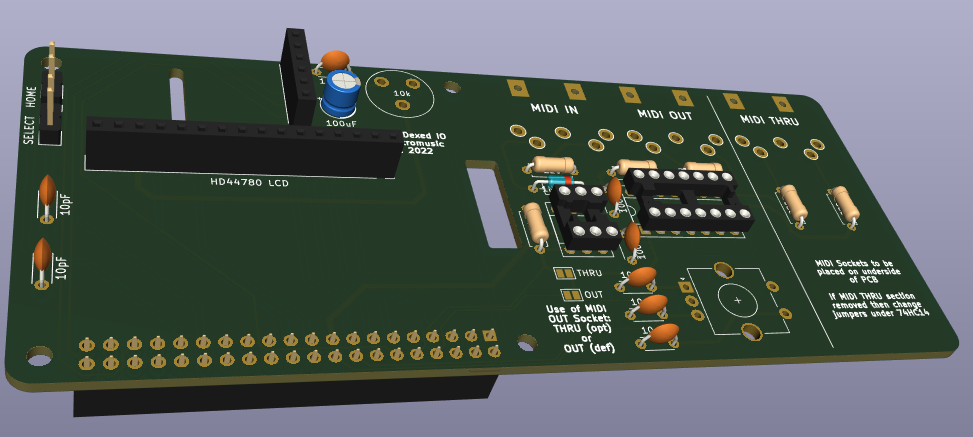
MiniDexed RPi IO Board (HD44780 Version)
Again starting a new KiCad project from the Raspberry Pi 40-pin extension board template, this is the circuit I’m working with for this one.
Schematic Notes:
- This is using the same PCM5102, rotary encoder, and switches as above (although I’ve just realised I never swapped the schematic and pcb over to use the GY-PCM5102 module symbol and footprint – oh well, for this board it is a 6-way set of headers!).
- This uses the “data interface” version of the HD44780. I did think about using the I2C version, but thought this would be the simplest case to build if it could be made to work.
- There is MIDI IN, OUT and (optional) THRU.
- The MIDI circuit borrows heavily from Clumsy MIDI and includes a 74HCT14 hex inverter as an output buffer for OUT and THRU (although it is labelled as a 74HC14 on the schematic and pcb).
- THRU is optional, in which case the unused inputs to the 74HCT14 should go to GND instead (selected by solder jumpers).
- OUT can optionally be changed to a(nother) THRU rather than an OUT, in which case it can be switched via solder jumpers to be connected to RX0 rather than TX0.
To simplify the routing of the PCB, the pinouts for the various components have changed. Here is the pinout being used (this is now quite different to the original MiniDexed pinout).
So this is the design for the pcb that has been sent off for manufacture:
Design notes:
- The PCB is designed to be used with a Raspberry Pi “upside down”. That is, with the connectors at the top, and GPIO at the bottom. This means the USB/RJ45 ports will be on the left hand side, as shown.
- The MIDI THRU section is optional. If only two MIDI sockets are required that part of the board can be cut off along the line indicated. If that is done then the solder jumpers beneath the 74HC14 must be changed as follows:
- Cut the “THRU” jumper (this disconnects the 74HC14 from RX0).
- Solder the “NO THRU” jumper (this connects the unused 74HC14 port to GND).
- The MIDI OUT port can be changed to a THRU too. If the original THRU is removed, this means you can just have MIDI IN and THRU instead of IN and OUT if you wish. If the original THRU is retained, then you can have a MIDI IN and two THRUs. To turn the OUT into a THRU change the two solder jumpers near the H11L1 as follows:
- Cut the “OUT” jumper (this disconnects the OUT circuit from TX0).
- Solder the “THRU” jumper (this connects the OUT circuit to RX0 to make it a THRU).
- Whilst on the subject of MIDI sockets, all three sockets are oriented to go underneath the board so they will go alongside the RPi.
- The optional buttons are not provided on the PCB, but via two sets of headers on the left hand side of the board.
- As mentioned above, annoyingly I forgot to change the PCM5102 footprint to that of a GY-PCM5102 module, so there are no holes for the additional 9-way header. These are not used electrically, but they would have provided some additional physical support. Instead I might solder some header pins and use the plastic pin spacer as a support under the board (but I’ll look into that when I get the boards back).
- I’ve included a simple “preset” pot to control the contrast for the LCD.
- Once again I used a filled zone to create a link to the GND net and provide a ground plane on the rear copper layer of the board. Note that I left a cut-out under the traces to the THRU part of the circuit, to reduce the chance of a short if the board is cut off at this point.
- Most LCD1602/HD44780 modules are 5V parts, with 5V required to ensure the LCD actually illuminates successfully. However, as described here, it is usually ok for a 3V3 output to drive a 5V input, so as long as the LCD isn’t attempting to drive the IO pins for the Pi, the Pi should be fine talking 3V3 to the LCD. So that is the approach I’m taking. It does mean that this won’t accept a 3V3 LCD module. But in all this, remember my level of electronics experience, and make up your own mind…
Manufacturing
Both boards should be built using the standard, cheapest manufacturing options. Both are fine with a 6/6 mil constraint on track width and separation.
The second board is somewhat larger than the common “cheap” tier. For me, all my other boards were $4.60 plus postage for 10 boards, but the larger one has jumped up to around $27 plus postage.
On the back of my first blog post, having used Seeed Fusion to produce my first boards, they sent me some money off vouchers, so I’ve used them once again here. That was particularly welcome given the increased cost of the larger board!
I still don’t really have a space to store these designs. But I’ll update this post when I do!
Closing Thoughts
Although either of these designs could potentially be used in a case to make a nice, small, self-contained unit, I can’t guarantee that the spacing of connectors and components will really allow it. I’m also not sure what will be required in terms of cooling for the Pi, so I’ll have to see how I get on. It may be that I’ll need more spacing between the Pi and the IO board.
I’m still learning with KiCad, so am fully expecting continued mistakes or odd design choices, but I think both of these will be interesting to try.
Update: mistakes already spotted since sending them off:
- The afore-mentioned GY-PCM5102 footprint error.
- Labelling on the board states 74HC14 and it really has to be a 74HCT14.
So that is the walk-through of the design of these boards. Of course I won’t really know if they are successful until I get the boards back from manufacturing!
Kevin
#hd44780 #midi #minidexed #pcb #pcm5102 #raspberryPi #ssd1306
Show Original Post
blog (@blog@interlan.ec)
Una de las cosas mas útiles que he deseado tener disponible, es acceder a un terminal mediante SSH inverso a mi computadora persona, desde cualquier parte del mundo. He conocido herramientas como ngrok y localtunnel que sirven, mas o menos, para lo que necesito, pero quería intentar con una herramienta que no dependa de servidores externos y ajenos a mi poder, sea porque no quiero compartir mis datos con terceros, o porque simplemente quería aprender a hacerlo por mi mismo.
Luego de mucho investigar, he encontrado algo que existe desde hace mucho tiempo y que probablemente es conocido por todo el mundo, pero recién aprendí a hacerlo por mi cuenta; SSH permite hacer túneles inversos.
Tabla de contenidos
- Tabla de contenidos
- Esquemas de control remoto
- La gran nube
- Acceder a un terminal mediante SSH inverso
- Desarrollo de la Solución
- Bibliografía/Webgrafía
Introduccion
No es raro tener que acceder a una consola aislada en una red privada, a veces hace falta revisar alguna situación extraña, como escaneos sospechosos en un servidor o editar algo de código. Aquí explico mas sobre este tema.
https://interlan.ec/2022/06/06/revisando-los-logs-de-mi-server-w00tw00t-scan/
Esquemas de control remoto
Desde el periodo de confinación por el COVID-19, todo tipo de servicios se hicieron sumamente populares, como zoom para las conferencias, y AnyDesk para trabajo remoto.
Aunque es de conocimiento común, se puede controlar un equipo utilizando el modelo Cliente-Servidor, donde el cliente se conecta al servidor y el servidor responde a sus peticiones.
Modelo Cliente-ServidorEn este modelo, el equipo a controlar debe ser el servidor, es decir, debe mantenerse escuchando para poder responder las peticiones del cliente, es decir, el controlador.
Este modelo es sencillo si hay conexión directa entre el cliente y el servidor, por lo que se puede utilizar la siguiente combinación de programas para el acceso remoto:
- SSH – SSHd Acceso mediante consola (y montones de trucos mas).
- RDP/XRDP – Escritorio remoto de Windows/Remina(Linux) Acceso mediante escritorio remoto usando el protocolo RDP de Windows.
- Vino-Vinagre Acceso mediante VNC que admite múltiples sistemas operativos.
El problema entonces es que todo esto funciona en una red local, pero no a través de internet.
La gran nube
La red de redesPodríamos definir a internet como la red que une a muchas redes pequeñas mediante un mapa de rutas complejas trazado por algoritmos aun mas complejos de entender.
Inicialmente, los proveedores de internet buscan conectar un solo dispositivo a internet, pero en una casa, esto no es lo ideal. Hay muchos dispositivos y cada día parecen haber mas, por lo que una sola conexión no abastecería.
Para solucionar esto, se crea una pequeña red local mediante routers que guiaran todas las conexiones hacia el exterior.
Es probable que por seguridad el proveedor de internet haya limitado las conexiones del router a solo salientes, por lo que no hay forma de conectarse desde afuera.
También es probable que el mismo proveedor haya creado una infraestructura compleja de subredes anidadas que dificultan aun mas encontrar el camino hacia un equipo en especifico desde el exterior. Casi cualquier dispositivo que no esté en la red local, estará en la misma situación, por lo que la comunicación entre ambos es virtualmente imposible.
Acceder a un terminal mediante SSH inverso
Internet es una maraña de dispositivos conectados, pero si alejamos lo suficiente nuestra perspectiva, nos daremos cuenta de que en realidad, parece una gigantesca red local.
Esto significa que es posible conectarse a algún nodo que tenga conexión directa y publica a internet, utilizando lo que es llamado IP Pública
Algunos proveedores de internet ofrecen el servicio de IP publica a sus clientes, por lo que ajustando algunas configuraciones en el router, ya se puede acceder desde cualquier parte del mundo a nuestro equipo, pero esto es innecesariamente peligroso, por cuanto internet es un lugar plagado de atacantes buscando vulnerabilidades en cada IP que puedan encontrar.
Para resolver esto y evitarle a los clientes todo tipo de pesadillas, las empresas proveedoras de servicios de control remoto, crearon servidores de conexión inversa, que sigue un modelo de Cliente – Servidor – Cliente.
Modelo Cliente Servidor ClientePara este ejercicio, vamos a imitar el modelo que utilizan las grandes empresas y crearemos un puente para alcanzar algún equipo de nuestra red local, desde cualquier parte de internet.
Desarrollo de la Solución
Aunque técnicamente se puede realizar con solo dos dispositivos, lo mas común es que se necesiten tres, así que enumeraremos los requisitos a continuación:
- Dispositivo de destino: Se encuentra aislado en una red local. y es incapaz de recibir conexiones entrantes debido a la configuración de su red y su proveedor de internet, pero puede ejecutar conexiones salientes a cualquier parte de internet.
- Servidor SSH Puede ser cualquiera, como OpenSSH o Dropbear. Nota importante: el dispositivo debe tener instalado algún servidor SSHd. He hecho pruebas con termux en Android y, aunque tiene uno, su problema esta relacionado con que no permite el login de usuario y contraseña, para lo cual se deben usar otros métodos de autenticación.
- Cliente SSH Puede ser cualquiera.
- Servidor: Se encuentra en un lugar accesible de internet y permite conexiones entrantes o salientes libremente. Generalmente es un servidor, pero puede ser cualquier dispositivo mientras tenga una IP pública.
- Dispositivo de salida: Generalmente está en la misma situación que el dispositivo de destino, pero en otra red. lo importante es que tenga conexión saliente hacia el servidor.
Seguramente ya dispones de los dispositivos de destino y de salida, pero el servidor es algo menos probable, así que, por que no arriesgarse con un droplet de Digital Ocean?
Utilizando este enlace puedes crear una cuenta con un crédito inicial de 100 dólares, totalmente sin costo durante 60 días. Úsalo para aprender y practicar con servidores Linux y cuando se acabe el periodo de prueba, puedes comprar Droplets desde 5 dólares mensuales. Recuerda administrar responsablemente tus VPS para evitar sorpresas al final del mes.
Ahora vamos a empezar a aplicar la configuración de los distintos dispositivos implicados:
Dispositivo de Destino
Este dispositivo, que se encuentra atrapado en una red que no permite conexiones entrantes, va a permanecer conectado todo el tiempo al servidor para que el túnel se mantenga vivo. Eso significa que la ventana del terminal tendrá que mantenerse abierta en todo momento o de lo contrario el túnel morirá.
Esto también sucede en las las aplicaciones de control remoto, pero es mas transparente al usuario debido a que utilizan servicios para mantener vivo el cliente y revivir el túnel cada que sea necesario. Aquí se puede realizar algo similar, enviando la conexión al fondo mediante screen u otras herramientas.
En el dispositivo de destino, hay que escribir lo siguiente
ssh -R 16789:localhost:22 usuario@servidordonde:
- ssh Inicia la aplicación de shell segura.
- -R 16789:localhost:22 vincula un puerto arbitrario(de nuestra elección) en el dispositivo de destino, al puerto 22 del servidor SSHd.
- 16789 es un puerto arbitrario, es decir, podemos poner cualquiera, siempre que sea un puerto libre en nuestro equipo.
- localhost o 127.0.0.1 es la dirección local de nuestro dispositivo.
- 22 es el numero del puerto al que vamos a redirigir la conexión entrante. En este caso, es el puerto de SSHd.
- usuario@servidor
- usuario Es el nombre del usuario existente en el servidor al que nos vamos a conectar y utilizar de puente.
- servidor Es el nombre de dominio o dirección IP del servidor al que nos estamos conectando.
Al ejecutar este comando, se abrirá una conexión con el servidor, que deberás mantener viva tanto como quieras acceder por el túnel inverso. Por supuesto, mientras estas en ese túnel, puedes usar libremente al servidor como si fuera una conexión normal.
Dispositivo de salida
Puede parecer raro comenzar por el dispositivo de salida, pero asumiremos que en el servidor ya está SSHd bien configurado.
En el dispositivo de salida deberás acceder al servidor con una conexión normal de SSH
ssh usuario@servidorDonde:
- ssh Es el comando de la consola segura
- usuario@servidor
- usuario Es el usuario del servidor
- servidor Es el nombre de dominio o la dirección IP del servidor
Una vez que haya una sesión iniciada en el servidor, debemos ejecutar este comando y tendremos acceso a la consola del dispositivo de destino.
ssh usuario@localhost -p 16789Donde:
- ssh Es el comando de la consola segura.
- usuario@localhost Es el usuario del dispositivo de destino.
- usuario es el usuario del dispositivo de destino.
- -p 16789 Es el puerto que abrimos en el dispositivo de destino.
Si queremos acceder a nuestro dispositivo de destino, hemos de dejar encendido el túnel, pero una falla de la red podría causar que la conexión se cierre. Al no estar cerca del equipo para restaurar la conexión, no podremos revivir el túnel hasta que volvamos presencialmente a restaurarla, así que lo recomendable es utilizar una herramienta que reviva el túnel cada que sea necesario o utilizar un cliente que pueda mantener conexiones persistentes a pesar de los quiebres de red.
Mientras tanto, se pueden utilizar sin problema los demás protocolos que funcionan sobre SSH, como SFTP o SCP por ejemplo.
Eso si, hay que recordar que para conectarse, hay que usar el puerto arbitrario que hemos definido anteriormente.
SFTP:
sftp -oPort=16789 usuario@localhostSCP
scp -p -P 16789 /tmp/ssh.txt usuario@localhost:Hay muchas dudas que me quedan pendientes pero las iré estudiando conforme vaya necesitando mas cosas, pero tener este túnel es algo interesante para practicar.
Bibliografía/Webgrafía
Túnel inverso. Obtenido de :https://mundo-hackers.weebly.com/tuacutenel-inverso-ssh.html
https://interlan.ec/blog/2022/07/20/acceder-a-un-terminal-mediante-ssh-inverso/ #DIY #experimentos #SSH #SSHTunneling #túnel #tunel
Show Original Post
madargon (@madargon@is-a.cat)
Sad illustration...
I had first vision for this after reading some chapters of "Permanent Record".
#drawing #comic #internet #freedom #privacy #corporations #socialmedia

Show Original Post
the-smartest-messaging-method-is-not-a-segregated-mess-of-whatsapp-signal-telegram-sms-slack-teams-facebook-instagram-wechat-etc (@the-smartest-messaging-method-is-not-a-segregated-mess-of-whatsapp-signal-telegram-sms-slack-teams-facebook-instagram-wechat-etc@bookofadamz.com)
The smartest messaging method is not a segregated mess of WhatsApp, Signal, Telegram, SMS, Slack, Teams, Facebook, Instagram, WeChat, etc.

Show Original Post
2022 (@2022@nosgustalinux.es)
Cómo instalar Docker en Debian 11 Bullseye: https://nosgustalinux.es/2022/07/como-instalar-docker-en-debian-11/ #APT #Debian #Debian11 #Destacado #Devops #Docker #Servidores
Show Original Post
blog (@blog@interlan.ec)
El articulo a continuación es una bitácora del desarrollo de un bot o plataforma de bots que actualmente tengo funcionando. Se puede acceder usando el siguiente URL: Descargar_Musica
https://interlan.ec/2022/02/15/actualizacion-del-estado-del-bot-de-descargar-musica/
He comenzado esta especie de portafolio con un pequeño bot de Telegram para descargar música desde YouTube. Para esto, he recurrido a las siguientes tecnologías:
Los cambios que he realizado recientemente son muy escasos. Mi conocimiento sobre javascript es relativamente superficial, por lo que he decidido aprender clases, módulos y librerías en javascript. Debido a esto, ahora se han realizado los siguientes cambios:
Creación del directorio data/descargar_musica/descargas
Con el fin de crear un sistema de control para bots unificado, he creado este directorio para que en el futuro, pueda agregar mas directorios de datos para cada bot. En esta situación en especifico, este cambio se hace por la necesidad de asegurar que si hay datos corruptos o incompletos, o un sistema de borrado deficiente, al modificar o borrar los archivos, esto no afecte a otros bots o al propio código fuente.
Creación de las librerias db_logging_system y telegram_logging_system
Con el fin de crear un código mas simple y fácil de mantener, he creado estas librerías universales, que permiten registrar a los nuevos usuarios que utilicen el bot y otra que registre los eventos en un canal distinto.
PD: Sigo sin entender mucho esto, pero ahi logre hacerlo funcionar.
Creación de un vídeo tutorial
Este bot no tiene mayor complicación. Lo único que requiere es que envíen un enlace y comienza a trabajar, sin embargo, siguen mandandole enlaces de spotify e incluso itunes. Si bajar música de estas plataformas fuera legal (y hubiese alguna ganancia aparte de practicar programación) seguro que implementaría una función adecuada, pero por el momento, esto no es asi.
Telegram tiene muchas funciones interesantes y una de mis preferidas son los bots inline. Es posible conseguir la url de un vídeo de youtube, usando el bot @vid y una vez seleccionado el vídeo, mi bot comenzará a trabajar.
Tutorial uso bot inline youtubeUso de los directorios data/descargar_musica/descargas y data/descargar_musica/info
En la revisión anterior, los vídeos se descargaban en el mismo directorio de ejecución. Sean estos archivos temporales o archivos completos, todos se guardaban sin reparo allí, por lo que si ocurría un error o el sistema caía abruptamente, este directorio que contiene los ejecutables, se llenaba de basura que era difícil de limpiar. Para esto, se ha creado el directorio descargas, dentro de uno asignado al bot en cuestión, donde irán todas las descargas realizadas y las que hayan fallado también.
el directorio info, existe en cambio para guardar datos permanentes que no son parte del código, como el vídeo instructivo mencionado previamente
Otros cambios
- Se agregaron mas registros para mas eventos (errores, eventos, arranque y comandos)
- Se limpió el código aplicando las nuevas librerías creadas
- Se optimizo el tiempo de respuesta del bot
- Se agregaron nuevos mensajes de respuesta
- Se agregaron nuevas instrucciones para situaciones no controladas
- En caso de introducir un enlace no reconocido, se agregó la misma instrucción del comando sobre_mi.
- En caso de haber un error al descargar, se agregó un mensaje de notificación.
- En caso de haber un error al convertir el archivo.
- En caso de haber un error al eliminar los archivos temporales.
Proximos cambios
El bot ya se encuentra en un estado bastante aceptable para lo que queria aprender, pero deseo aprender mas cosas, por lo que espero poder agregar lo siguiente:
- Registro particular para cada bot (sistema «Panoptic»)
- Control de depuración por comandos para el bot
- Control web para el bot
- Control general para todos los bots en el sistema
- Mejor registro de información común
- Mejor registro de información especifica
- Control personalizado de acuerdo al usuario
- Integración con otras plataformas de bot (discord, twitch, etc)

Show Original Post
w (@w@tube-numerique-educatif.apps.education.fr)
ENTrevue Peertube - DRANE Grand Est - Site de Reims
https://tube-numerique-educatif.apps.education.fr/w/cPkD53UtzawRj3SzndJypJ
Show Original Post
w (@w@tube-numerique-educatif.apps.education.fr)
Présentation du portail tubes
https://tube-numerique-educatif.apps.education.fr/w/koKWnHzNAqntRxG3wdvLyV
Show Original Post
2022 (@2022@lanzatu.blog)
Novedades de WordPress 6.0
Con más de 1000 cambios, las novedades de WordPress 6.0 representan un avance en la evolución hacia la edición completa del sitio (FSE).https://lanzatu.blog/2022/05/26/novedades-de-wordpress-6-0/

Show Original Post
2022 (@2022@blog.clickomania.ch)
Bei Facebook blockiert?
Es gibt die grossen Gründe, um Facebook abgeneigt zu sein: der miese Datenschutz, die fragwürdigen, undurchschaubaren Algorithmen, das Versagen bei Fakenews, Desinformation und Propaganda – und so weiter.
[caption id=“attachment_22512″ align=“alignright“ width=“139″] Claudio Zanetti hat mich blockiert. Und ich habe es verkraftet.[/caption]
Es existieren auch kleine Gründe, weswegen man über Mark Zuckerbergs Plattform die Nase rümpft. Einer davon ist die Art und Weise, wie die Beziehungen gemanagt – oder nicht gemanagt – werden. Während einem Twitter ins Gesicht sagt, wenn man von einem Nutzer blockiert worden ist, macht Facebook alles, um einem diese Information vorzuenthalten.
Warum? Geht es darum, meine Nerven zu schonen und meine Gefühle nicht zu verletzen? Falls das die Ursache sein sollte, dann wäre das an Scheinheiligkeit nicht zu übertreffen. Denn so lange man nicht blockiert worden ist, darf man sich auch üble Dinge an den Kopf werfen, ohne dass das Konsequenzen hätte. Denn Facebook bekämpft die Hassrede ein wenig, wiegelt aber gleichzeitig ab.
Ich habe neulich an einem konkreten Beispiel durchexerziert, wie aus Corona-Leugnern Putin-Fans werden. Der Facebook-Post, den ich als Grundlage für meine Argumentation genommen habe, stammt von Angela H.B., deren Profil ein paar Tage nach meiner Berichterstattung nicht mehr zugänglich war. Beim Aufruf des fraglichen Beitrags erschien bloss die Meldung: «Dieser Inhalt ist derzeit nicht verfügbar».
[caption id=“attachment_22511″ align=“aligncenter“ width=“616″] «Dieser Inhalt ist derzeit nicht verfügbar» – ein Rumgeeiere sondergleichen.[/caption]
Natürlich lag die Vermutung nahe, dass sie sich von mir nicht länger anhören wollte, sie sei ein willfähriges Sprachrohr für Putins Propaganda. Aber es standen auch zwei andere Möglichkeiten im Raum: Facebook hätte ihr Profil sperren können, weil ich ihren Post als Fehlinformation gemeldet hatte. Oder sie hätte selbst ihrer Karriere in diesem sozialen Netzwerk ein Ende setzen können, zumal sie sich auch von einigen meiner Freunde harte Kritik hat gefallen lassen müssen.
Facebook lässt einen im Unklaren
Aber welche der drei Möglichkeiten ist es denn nun? Die Facebook-Sperrung erschien mir unwahrscheinlich, da man es normalerweise eine Rückmeldung gibt. Doch auch die Blockierung durch Angela H.B. erschien mir nicht plausibel. Denn ihre Kommentare unter meinen Posts waren noch vorhanden – ich war jedoch der Meinung, dass die bei einer Sperre ganz verschwinden.
Wie lässt sich das herausfinden? Es gibt im Netz diverse Anleitungen, die aber oft nichts taugen. Meines Erachtens gibt es nur zwei brauchbare Methoden:
Wenn die fragliche Person ihre Posts mit der Zielgruppe Öffentlich publiziert hat und ein Link zu einem der Posts greifbar ist, dann verwendet man entweder einen Browser, bei dem man bei Facebook nicht eingeloggt ist oder man öffnet ein privates Fenster (auch Inkognito-Fenster genannt) und gibt dort den Link ein. Wenn der Beitrag erscheint, dann ist der Fall klar: Man wurde blockiert.
Sollte der Blogpost nur für ein eingeschränktes Publikum veröffentlicht worden sein, dann bittet man einen Freund, nach dem Namen der fraglichen Person zu suchen. Wenn er fündig wird, dann ist die Sache ebenfalls eindeutig: Man wurde blockiert.
Der Trick mit dem Zweit-Konto
Man kann stattdessen auch ein zweites Facebook-Konto einrichten und das für die Suche verwenden. Ich bin diesen Weg gegangen, und er hat Gewissheit gebracht: Angela H.B. hat mich blockiert. Gleichzeitig konnte ich mich davon überzeugen, dass der ursprüngliche Beitrag weiterhin online ist und sich Facebook offensichtlich nicht daran stört, wenn mutmassliche Kriegsverbrechen geleugnet werden.
Interessantes Detail am Rand: Mein Zweit-Facebook-Account, den ich für kleine Überprüfung eingerichtet habe, hat keine halbe Stunde überlebt. Facebook hat ihn nach einigen wenigen Klicks deaktiviert, weil er «gegen die Gemeinschaftsstandards verstossen» habe.
[caption id=“attachment_22510″ align=“aligncenter“ width=“805″] So sei es.[/caption]
Wenn man sich ansieht, was alles nicht gegen die Gemeinschaftsstandards verstösst, dann ist diese Begründung hanebüchen – ich habe nichts getan, ausser ein paar öffentliche Posts anzusehen. Ich gehe davon aus, dass ein Algorithmus geschnallt hat, dass ich versucht habe, die Sperrung zu umgehen. Das dürfte daran liegen, dass ich mit beiden Konten von der gleichen IP-Adresse aus zugegriffen habe.
Warum nicht mal Tacheles reden?
Doch um es klar zu sagen: Die Sperrung meines Zweit-Kontos ist richtig. Es handelt sich um eine Massnahme gegen Stalking, das, wie man weiss, auch mittels sozialer Medien betrieben wird. Aber warum windet sich Facebook auch hier um Klartext herum und schreibt wolkig vom «Verstoss gegen Gemeinschaftsstandards, statt den Vorwurf – «Wir glauben, dass du Angela H.B. stalken möchtest» – klar zu benennen?
Und damit sind wir wieder beim Anfang: Wenn Facebook keinen Eiertanz aufführen würde, wenn jemand einen blockiert, dann wäre diese Stalking-verdächtige Nummer gar nicht nötig gewesen.
Übrigens: Die Experten raten dazu, bei Stalking klare Grenzen zu setzen: «Machen Sie der Stalkerin/dem Stalker einmal und unmissverständlich klar, dass Sie keinen Kontakt (mehr) wünschen; im Idealfall vor Zeugen und/oder schriftlich festgehalten», heisst es bei der Schweizerischen Kriminalprävention.
Auch darum sollte Facebook nicht diese seltsame Ghosting-Methode anwenden, sondern Sperrungen klar als solche benennen. Denn zum anständigen menschlichen Umgang gehört nun einmal, dass auch Beziehungen ordentlich beendet werden: So geht entfreunden. Konfliktscheue bringt nichts. Und man schleicht nicht einfach davon.
Beitragsbild: Wieder einmal ein Daumen nach unten für Mark Zuckerberg (Markus Spiske, Unsplash-Lizenz).
#Facebook
Show Original Post
blog (@blog@shkspr.mobi)
MSc Assignment 5 - Professional Practise 1 - Machine Learning in Python
I'm doing an apprenticeship MSc in Digital Technology. In the spirit of openness, I'm blogging my research and my assignments.
This is my paper from the PP1 module - where I take some CPD related to my profession. I picked Machine Learning in Python.
I've blogged about the course itself. The middle two parts of this paper are about that - why I chose it and how I put it into practice. The first and fourth parts are, as far as I can tell, unrelated. We have to write about reflection in the workplace. I am not very introspective, and I don't really enjoy it. So it was somewhat tedious to churn out. The final part was about ethics which at least had the advantage of being interesting.
Nevertheless, I was happy with a mark of 76%. (In the English system 50% is a pass, 60% is a commendation, 70% is distinction.)
I used my algorithm to write an assignment to complete this.
A few disclaimers:
- I don't claim it to be brilliant. I am not very good at academic-style writing.
- It is fairly inaccurate. Many of the concepts on reflection were not relevant to my workplace, so there is a lot of fudging.
- This isn't how I'd write a normal document for work - and the facts have not been independently verified.
- This isn't the policy of my employer, nor does it represent their opinions. It has only been assessed from an academic point of view.
- It has not been peer reviewed, nor are the data guaranteed to be an accurate reflection of reality. Cite at your own peril.
- I've quickly converted this from Google Docs + Zotero into MarkDown. Who knows what weird formatting that'll introduce!
- All references are clickable - going straight to the source. Reference list is at the end, most links converted using DOI2HT.ML.
And, once more, this is not official policy. It was not commissioned by anyone. It is an academic exercise. Adjust your expectations accordingly.
Table of Contents
Abstract
In this paper, the author reviews several models of reflection and determines which is most suitable for their current industry and workflow.
The author then describes the selection process of a Continual Professional Development course. This is done by examining their Personal Development Plan, and in conjunction with the needs of their employer.
After taking a short course on statistics and algorithms, the author discusses their application to a specific cybersecurity issue within Government (the specific details are deliberately kept confidential due to national security concerns - as agreed by lecturers). They investigate how this sort of analysis can be integrated into a modern data process. They also discuss other methods of analysing data and how they compare to the recently acquired knowledge. This section concludes with a reflection on the application of this newly acquired knowledge.
Finally, the author looks at how a culture of reflection can develop within their organisation, and how that integrates with the needs and responsibilities of a modern data analytics professional.
1. A critical review of three reflective models
The author has rarely experienced structured reflection in the workplace. Although the UK Civil Service engages in annual appraisals (Fletcher, 2008), they are often performative rather than substantive. Additionally, there is little evidence that reflection makes a difference in a digital organisation (Dors et al., 2020). This lack of evidence makes it challenging to compare the utility of different reflective models.
The author's review of the assigned reading material suggests that the three most common models across a variety of industries are "DIEP" (Rogers, 2001), "What? So what? Now what?" (Driscoll, 2007), and Moon's levels of learning (Moon, 2013). These are evaluated by the author in Table 1.
Table 1 - Evaluation of three reflective models DIEP What? So what? Now what? Moon's levels of learning Strengths Structured model which is well used in industry.Can be used for individuals or teams.
Brief, and easy to completeOption to drill down into each question for further reflection.
Relies on a "common sense" understanding between users.Well understood for reflections on learning.
Weaknesses Model is rigid and may not apply in every situation.Takes up a lot of time.
Primarily designed for the nursing profession.Limited use / acceptance in digital workplaces.
Several steps - so may be burdensome to complete.Overly focused on emotions, to the exclusion of more practical matters.
1.1 Sources
Reflection generally focuses on the writer's "experiences, thoughts, feelings and assumptions" (Bassot, 2016 (p. 16)). The author recognises there is an urgent need for better reflective models which take into account the different ways that individuals relate to reflection (Roberson et al., 2021). Structured reflective practice also needs to take into account that different people may have different learning styles (Pashler et al., 2008).
1.2 Comparison of practices
The author's organisation relies heavily on "Capability Frameworks" in order to judge the competencies of staff (Uk Government, 2020). The Digital, Data and Technology framework provides a model whereby staff can self-assess against a series of skills and behaviours. The ability for staff and their managers to be able to reflect on performance in a structured way is necessary for the continued professionalisation of technologists working in the Civil Service (Thornton, 2018). However, "soft skills" are considered essential to the modern workplace (Lepeley et al., 2021). In the author's opinion, a purely technical approach to reflection will therefore be limited.
Theoretical frameworks have not been well received in the author's organisation. Instead, there is a strong focus on the “technical‐rational approach” (Chivers, 2003). For organisations which are focused on delivering technical outcomes, the author believes that most reflective models are too focused on an individual's feelings. While workplaces have to take pastoral care of their staff, there is a trend in modern workplaces to become "neo-paternalistic" (Leclercq-Vandelannoitte, 2021) and attempt to cater to the development needs of their staff. Given the range of personality types in the typical workspace (Russo & Stol, 2020) it is not practical for an employer to impose a "one size fits all" reflective model for their employees to follow.
1.3 Conclusion
In the author's opinion, DIEP provides a reasonable model for general reflection without an over-reliance on emotional introspection. This is more suitable for people who are neurodiverse and struggle with articulating and assessing their emotions.
2. A discussion of the selection of CPD in relation to the wider technical area
2.1 Description
I chose a course designed to enhance the skills of people with basic data science skills - the full details of which are in Appendix C. It was based on the Python programming language developed by Guido van Rossum (Pajankar, 2022). It covered the basics of Extract-Transform-Load (ETL) (Theodorou et al., 2017) - whereby data are read, corrected, and manipulated. It also taught relevant Machine Learning (ML) packages such as numpy, pandas, MatPlotLib and SciKitLearn. This was particularly important for me because these Python packages are used extensively in the UK Government (GitHub, 2022). Outside of Government, Python is one of the most widely used programming languages for ML (Stancin & Jovic, 2019).
2.2 Relevance
Data science has proved invaluable to the worldwide response to the COVID‑19 pandemic - with Python and open source workflows proving popular (Malarvizhi et al., 2021). While analytics has a long history - especially in Government responses to medical data (Anderson, 2011) - ML is relatively new and has only become practical thanks to the rapid increases in computer processing speeds (Fradkov, 2020).
I consider ML to be a suitable way to harness advances in stochastic models to investigate complex problems, in a manner similar to humans but at greater speed and accuracy.
2.3 Context
ML - and data science in general - is a priority for the current Government (Cummings, 2020). The ability to quickly and accurately model outcomes using data is a key pillar of the UK's National Data Strategy (Dowden, 2020). Departments across the organisation are already publishing guides on the use of ML (DSTL, 2020). As discussed above, ML is used widely outside of Government, and we wish to bring our organisation closer to industry norms.
2.4 Author's Role
My Personal Development Plan (see Appendix B) requires me to look for interesting opportunities. I felt that this CPD would help me expand my repertoire of skills and make me a more attractive candidate for future roles. It would build on my existing skills with the R statistical language and would enhance my ability to communicate effectively using data. I have recently started a new job which has a focus on protecting and maintaining part of the UK's Critical National Infrastructure (Weiss & Biermann, 2021) - specifically, its domain names. I needed a course which would enable me to quickly and comprehensively analyse large quantities of data and to make my analyses open, reproducible, and engaging.
2.5 Possible Alternatives
I also considered whether there were more suitable courses available. One option was a course in Cloud Operations. Governments across the world are investing heavily in moving computing resources to the Cloud (Busch et al., 2014). In collaboration with my manager, we concluded that our Cloud team was already fully resourced, so that course was rejected.
2.6 Evaluation
As my career progresses, I expect to have to engage more with the analysis and presentation of complex data sets. Given the strong emphasis on using ML within the UK Government, and Python's established use in my department, this is a suitable course for me at this stage of my career. I hope that the skills I gain will enable me to publish open source code and enhance the reputation of my department for publishing cutting-edge analytics.
3. An overview of how the CPD has been applied
3.1 An overview of the CPD
The course was based on the Python programming language (see Appendix C). The course taught the basics of both Pandas and Numpy - which are popular packages for visualising and analysing data. It briefly touched on modern ML techniques.
3.2 Identification of specific projects for which this CPD has had an impact.
Since the start of the COVID‑19 Pandemic, statistics and data investigation has become hugely important to the public. The power of predictive data and analytics is now at the forefront of the political agenda, with data being at the heart of the UK National Action Plan for Open Government (CDDO, 2022). It is believed that opening and analysing government data could generate huge public value (Zhang et al., 2015).
The specific project involves the Government's commitment to securing critical national infrastructure. My team has been given responsibility for analysing certain patterns of behaviour. With a large historic dataset, the team was asked to analyse the data to understand what insights could be gained. The aim was to make predictions about current data based on historic data.
A fundamental part of understanding the insights to be gained from ML is the "Cross-industry standard process for data mining" (CRISP-DM) (Chapman et al., 2000). This cyclic method is illustrated in Figure 1 below.
The use of Python's ML packages was essential to analysing and visualising the data. With a large historic corpus of events, I was able to train up an experimental model to look for patterns in the data which could be considered suspicious. By isolating some of the training data and keeping it as a validation set, I was able to test whether the model's accuracy was sufficient to enhance our team's work. The model was then tested on "live" data to see whether it could detect anomalies faster than our existing processes.
3.3 Detailed discussion and evidence of technical knowledge acquired in relation to the targeted apprenticeship standard
Having a large number of measurable parameters results in an unmanageable number of permutations of variables - this is known as the "curse of dimensionality" (Bellman, 1957). This still causes challenges for modern analytics. A key task for analysts is to remove excess information, and to understand which variables produce statistical noise rather than signal. Modern ML algorithms combined with increased computer speeds, makes it easier to investigate multi-dimensional data and rapidly see which dimensions have a statistically significant effect on the end result.
The data set neatly fits into the "4 Vs" model of "Big Data" (Kepner et al., 2014). Given the velocity of new data, volume of total data, the variety of data sources, and veracity of the data, there are challenges around how to analyse and investigate issues in a coherent way. Before attempting to model the data, it might be necessary to use techniques like MapReduce to make the processing and extraction of raw data easier (Dean & Ghemawat, 2008).
It is insufficient to rely on hypothesis testing as the primary method of investigation. Instead the practitioner should engage in Exploratory Data Analysis (EDA) (Tukey, 1977). EDA allowed me to investigate what sort of information the data were likely to yield, rather than starting from a position that there was a predetermined hypothesis which could be validated. By engaging in early visualisation, I got an immediate sense of the "shape" of the data. Relying purely on statistical observations is often insufficient for understanding what the data represents, as is demonstrated in Figure 2 below.
Figure 02: The "Datasaurus Dozen". A synthetically generated dataset which all have identical means, Pearson coefficients, and standard deviations - and yet all look radically different (Matejka & Fitzmaurice, 2017).
There is a crisis of reproducibility in science (Baker, 2016). Even mathematically focussed disciplines like economics have foundational papers which are based on flawed Excel spreadsheets (Herndon et al., 2014). One way this can be countered is by the publication of "reproducible builds" - that is, an information governance pipeline which shows all the steps taken to ingest, manipulate, and analyse the data. Jupyter Notebooks have quickly become one of the most popular tools for publishing information transparently (Perkel, 2018). The CPD gave me a thorough grounding in the basics of Jupyter Notebooks, and I have begun to investigate how they can be used with sensitive Government data, in alignment with the FAIR data principles (Wilkinson et al., 2016).
3.4 CPD application effects
The work on Jupyter notebooks has had a profound effect on how I present data and share it with colleagues. By understanding common models and key algorithms, I was able to create an analytical solution to the specific problem my organisation faced. This has reduced the time and effort spent by the organisation when analysing complex security-related data.
3.5 Prior & current practices
Prior practises were generally not based around a real-time "data-pipeline" (Psaltis, 2017). Data were often relegated to CSV and spreadsheets. Data were occasionally stored on cloud service spreadsheets. This made systematic analysis difficult and led to a lack of data consistency. Without a defined data schema, it was not possible to get data from various sources in the same format - this led to several manual processes for ETL. The result was that data analysis was performed sporadically and there was a lack of homogeneity in presentations to senior stakeholders.
3.6 Alternative approaches
An alternative would have been to open the raw data to allow crowd-sourcing of threat intelligence - the so-called "armchair auditor" model (O’Leary, 2015). While it might be possible that casual observers could find threats in the data, and alert us to them, there are several risks. Opening sensitive log data could inadvertently expose vulnerabilities of which we were not aware, and which may be used against us. A middle-ground might be to publish santised historical data in the open and include Jupyter Notebooks with reproducible results. This would allow other researchers to build ML models based on real data.
3.7 Reflection on the application of the CPD
I will reflect on the application of the CPD using the DIEP model (Rogers, 2001) as discussed in §1.3:
Describe
An advanced course in ML with Python. It covered modern tools and generally accepted statistical techniques. I was able to apply some of these techniques to analyse our data.
Interpret
While my background gives me confidence in statistics, and I was reasonably familiar with R, I wished to gain more modern knowledge of how to apply new tools and techniques. Some of these new tools were useful.
Evaluate effectiveness
I found the use of Jupyter Notebooks to demonstrate the application of knowledge to be an excellent tool. I look forward to bringing that paradigm back into the workplace. Through this experience, I learned new techniques and became aware of how to apply my existing knowledge to a new subset of problems.
Plan for the future
I intend to publish more data analysis as reproducible and interactive notebooks. I will encourage my peers to do the same. I will engage further with the analytics profession in my organisation.
4. How a culture of ethics can be developed in the author's organisation
4.1 Development of ethical culture
The Civil Service relies on ethical behaviour from its employees in order to ensure that there is confidence in the way that the state is operated. Additionally, a culture of ethics is a necessary precondition for both social and economic progress (Murtin et al., 2018). In her 2002 Reith Lecture, the legislator Baroness O'Neil remarked that people's inability to investigate sources of information, and the disparate nature of sources, would lead to a fragmentation of trust (O’Neill, 2010).
It is unethical to have laws which are not open to public scrutiny (Kutz, 2008) - therefore the author considers it similarly unethical to base laws and policies on data which are not publicly available. The author concludes that the open publication of data and analysis is key to developing an ethical culture.
4.2 Practical Concerns
How does the Civil Service develop a culture which is ethical? Mandatory training is common in most organisations, although it is sometimes used to shift the liability for infractions from employer to employee (Allay (UK) Ltd v Gehlen, 2021). Training alone isn't enough to improve employee behaviour when it comes to protecting their own health (Martimo et al., 2008), and there's evidence that compliance training on ethical matters makes no difference to employee's behaviour (Dobbin & Kalev, 2018).
Within the author's organisation, there are informal reflective practices like show and tells. There are also formalised processes which form part of the design process. Finally, experiments with data are subject to ethics board approvals. This mixture of personal training and systemic attitudes to ethical issues should culminate in a culture which values and embodies ethical behaviour.
4.3 Role of professional
In the UK, approximately 72% of roles are unregulated (Tamkin et al., 2013). The information technology industry has resisted the application of ethical practices set by regulatory bodies. The medical profession, for example, has a long history of embracing formal standards - such as the Hippocratic Oath (Hulkower, 2016). Other professions, such as Canadian engineers, hold elaborate "Ritual of the Calling of an Engineer" ceremonies to impress upon graduates the necessity for ethical behaviour (Osman, 1984).
In contrast, information technology practitioners have non-mandatory professional bodies, such as the BCS and ACM. Historically, their codes of ethics (see Appendix D) are rarely enforced (Layton, 1986), and modern institutions are also similarly toothless (Sandy, 2005). The author considers this lack of formal and enforceable ethical conduct to be a deficiency when it comes to developing ethical norms.
In recent years, there has been a growth in the popularity of the "Code of Conduct" (CoC). These are documents which set out acceptable standards of behaviour for those participating in events, or as contributors to open source projects. Despite their overwhelming popularity in recent years (Tourani et al., 2017), there has been some resistance and hostility to CoCs. Some people believe their presence stifles free-speech and creativity (Whittington, 2018). The author believes CoCs set clear templates for behaviour, which removes the ambiguity which some people use as cover for their unethical behaviour. The author also considers CoCs to be an excellent way of tracking the changing nature of ethical norms within our communities - which will increase the industry's diversity and inclusivity.
4.4 Other factors
The author considers that the reputational risk of unethical practices should be foremost in the mind of Data Analysts. The tarnished reputations of organisations which engage in unethical methods, like Facebook (Véliz, 2020), should serve as a warning that ethical behaviour is not seen as optional in the public's consciousness. Regular competitive analysis should be performed, with focus on public perception of competitors' ethics. The author feels that this would help their organisation develop better ethical practices.
Regulations like GDPR & the Equality Act provide rules which an ethical professional cannot transgress. But the author does not consider that the law is the only method by which to determine morals, nor that teleological moral theories are sufficient. Instead, professionals need to have a thorough grounding in the kategorischer Imperativ (Kant, 1785). Data Analysts also need to be aware of modern guidelines which can help them develop a culture of ethics. The author recommends that close cooperation with the UK's Centre for Data Ethics should be a prerequisite of anyone working with sensitive data. Finally, the Civil Service Code sets out clear expectations of ethical behaviour for government employees (Fuertes, 2021).
4.5 Conclusion
There is a complex relationship between ethics and the data professional. It is not sufficient for a modern analyst to divorce their analytical process from the actions taken as a result of the analysis.
For example, it would have been unethical for the author to report a suspicious interaction to the security services based on the data analysis without first ensuring the rigour of the data and understanding the biases present in any training set.
As discussed in §3.2, it is not ethical to draw inferences from apparent patterns in the data without a thorough business understanding - i.e. an expert's view of the data.
Similarly, the open and transparent publication of the ML models and algorithms used by Government departments should be seen as an important step to developing ethical behaviour.
On reflection, there needs to be a greater emphasis in the Civil Service not just of the mechanics and application of modern ML techniques - but also on how to conduct such investigations in an ethical manner. Having a mandatory professional body for practitioners with an enforceable set of ethics would improve trust in both the individual Civil Servant and the state.
References
- Allay (UK) Ltd v Gehlen, (4 February 2021)
- Anderson, R. J. Florence Nightingale: The Biostatistician (2011) CLOCKSS Archive. doi:10.1124/mi.11.2.1
- Baker, Monya 1,500 scientists lift the lid on reproducibility (2016) Springer Science and Business Media LLC. doi:10.1038/533452a
- Bassot, Barbara The Reflective Journal (2017) Macmillan Education UK. doi:10.1057/978-1-137-60349-4
- Bellman, R. (1957). Dynamic programming. Princeton Univ. Pr. 9780691146683
- Busch, P., Smith, S., Gill, A. Q., Harris, P., Fakieh, B., & Blount, Y. (2014). A study of government cloud adoption: The Australian context.
- CDDO. (2022, January 31). UK National Action Plan for Open Government 2021-2023. GOV.UK.
- Chapman, P., Clinton, J., Kerber, R., Khabaza, T., Reinartz, T., Shearer, C., & Wirth, R. (2000). CRISP-DM 1.0: Step-by-step data mining guide.
- Chivers, Geoff Utilising reflective practice interviews in professional development (2003) Emerald. doi:10.1108/03090590310456483
- Cummings, D. (2020, January 2). ‘Two hands are a lot’. Dominic Cummings’s Blog.
- Dean, Jeffrey & Ghemawat, Sanjay MapReduce (2008) Association for Computing Machinery (ACM). doi:10.1145/1327452.1327492
- Dobbin, Frank & Kalev, Alexandra Why Doesn't Diversity Training Work? The Challenge for Industry and Academia (2018) Informa UK Limited. doi:10.1080/19428200.2018.1493182
- Dors, Tania Mara & Van Amstel, Frederick M. C. & Binder, Fabio & Reinehr, Sheila & Malucelli, Andreia Reflective Practice in Software Development Studios: Findings from an Ethnographic Study (2020) IEEE. doi:10.1109/cseet49119.2020.9206217
- Dowden, O. (2020). National Data Strategy. GOV.UK.
- Driscoll, J. (2007). Practising clinical supervision: A reflective approach for healthcare professionals.
- DSTL. (2020, December 7). Machine learning with limited data. GOV.UK.
- Fletcher, C. (2008). Appraisal, feedback and development: Making performance review work (4th ed). Routledge.
- Fradkov, Alexander L. Early History of Machine Learning (2020) Elsevier BV. doi:10.1016/j.ifacol.2020.12.1888
- Fuertes, Vanesa The rationale for embedding ethics and public value in public administration programmes (2021) SAGE Publications. doi:10.1177/01447394211028275
- GitHub. (2022). 195 results for all repositories written in Python. GitHub.
- Herndon, T. & Ash, M. & Pollin, R. Does high public debt consistently stifle economic growth? A critique of Reinhart and Rogoff (2014) Oxford University Press (OUP). doi:10.1093/cje/bet075
- Hulkower, Raphael The History of the Hippocratic Oath: Outdated, Inauthentic, and Yet Still Relevant (2016) Albert Einstein College of Medicine. doi:10.23861/ejbm20102542
- Kant, I. (1785). Grundlegung zur Metaphysik der Sitten. Hartknoch.
- Kepner, Jeremy & Gadepally, Vijay & Michaleas, Pete & Schear, Nabil & Varia, Mayank & Yerukhimovich, Arkady & Cunningham, Robert K. Computing on masked data: a high performance method for improving big data veracity (2014) IEEE. doi:10.1109/hpec.2014.7040946
- Kutz, C. (2008). The repugnance of secret law. USC Center for Law and Philosophy.
- Layton, E. T. (1986). The revolt of the engineers: Social responsibility and the American engineering profession (Johns Hopkins pbk. ed). Johns Hopkins University Press.
- Leclercq-Vandelannoitte, Aurélie The new paternalism? The workplace as a place to work—and to live (2021) SAGE Publications. doi:10.1177/13505084211015374
- Lepeley, M. T., Beutell, N. J., Abarca Melo, N., & Majluf, N. S. (2021). Soft skills for human centered management and global sustainability.
- Malarvizhi, Anusha Srirenganathan & Liu, Qian & Sha, Dexuan & Lan, Hai & Yang, Chaowei An Open-Source Workflow for Spatiotemporal Studies with COVID-19 as an Example (2021) MDPI AG. doi:10.3390/ijgi11010013
- Martimo, Kari-Pekka & Verbeek, Jos & Karppinen, Jaro & Furlan, Andrea D & Takala, Esa-Pekka & Kuijer, P Paul F M & Jauhiainen, Merja & Viikari-Juntura, Eira Effect of training and lifting equipment for preventing back pain in lifting and handling: systematic review (2008) BMJ. doi:10.1136/bmj.39463.418380.be
- Matejka, Justin & Fitzmaurice, George Same Stats, Different Graphs (2017) ACM. doi:10.1145/3025453.3025912
- Moon, Jennifer A. Reflection in Learning and Professional Development (2013) Routledge. doi:10.4324/9780203822296
- Trust and its determinants (2018) Organisation for Economic Co-Operation and Development (OECD). doi:10.1787/869ef2ec-en
- O'Leary, Daniel E. Armchair Auditors: Crowdsourcing Analysis of Government Expenditures (2015) American Accounting Association. doi:10.2308/jeta-51225
- O’Neill, O. (2010). A question of trust (5. printing). Cambridge Univ. Press.
- Iron Ring [From the Editor] (2016) Institute of Electrical and Electronics Engineers (IEEE). doi:10.1109/mcs.2016.2536098
- Pajankar, Ashwin Introduction to Python 3 (2022) Apress. doi:10.1007/978-1-4842-7410-1_1
- Pashler, Harold & McDaniel, Mark & Rohrer, Doug & Bjork, Robert Learning Styles (2008) SAGE Publications. doi:10.1111/j.1539-6053.2009.01038.x
- Perkel, Jeffrey M. Why Jupyter is data scientists’ computational notebook of choice (2018) Springer Science and Business Media LLC. doi:10.1038/d41586-018-07196-1
- Psaltis, A. G. (2017). Streaming data: Understanding the real-time pipeline. Manning.
- Roberson, Quinetta & Quigley, Narda R. & Vickers, Kamil & Bruck, Isabella Reconceptualizing Leadership From a Neurodiverse Perspective (2021) SAGE Publications. doi:10.1177/1059601120987293
- Rogers, Russell R.(2001) Springer Science and Business Media LLC. doi:10.1023/a:1010986404527
- Russo, Daniel & Stol, Klaas-Jan Gender Differences in Personality Traits of Software Engineers (2020) Institute of Electrical and Electronics Engineers (IEEE). doi:10.1109/tse.2020.3003413
- Sandy, G. (2005). Ethical Leadership of ICT Professional Bodies.
- Spruce, H. (2020, January 6). Free Personal Development Plan (PDP) Example Template PDF. The Hub | High Speed Training.
- Stancin, I. & Jovic, A. An overview and comparison of free Python libraries for data mining and big data analysis (2019) IEEE. doi:10.23919/mipro.2019.8757088
- Tamkin, P., Miller, L., Williams, J., & Casey, P. (2013). Understanding Occupational Regulation. UK Commission for Employment and Skills, Evidence Report 67, 141.
- Theodorou, Vasileios & Abelló, Alberto & Thiele, Maik & Lehner, Wolfgang Frequent patterns in ETL workflows: An empirical approach (2017) Elsevier BV. doi:10.1016/j.datak.2017.08.004
- Thornton, D. (2018). Professionalising Whitehall: Responsibilities of the Head of Function for Digital, Data and Technology. 12.
- Tourani, Parastou & Adams, Bram & Serebrenik, Alexander Code of conduct in open source projects (2017) IEEE. doi:10.1109/saner.2017.7884606
- Tukey, J. W. (1977). Exploratory data analysis. Addison-Wesley Pub. Co.
- UK Government. (2020, December 4). Digital, Data and Technology Profession Capability Framework. GOV.UK.
- Véliz, C. (2020). Privacy is power: Why and how you should take back control of your data.
- Weiss, Moritz & Biermann, Felix Cyberspace and the protection of critical national infrastructure (2021) Informa UK Limited. doi:10.1080/17487870.2021.1905530
- Whittington, K. E. (2018). Free Speech and the Diverse University (SSRN Scholarly Paper ID 3334118). Social Science Research Network.
- Wilkinson, Mark D. & Dumontier, Michel & Aalbersberg, IJsbrand Jan & Appleton, Gabrielle & Axton, Myles & Baak, Arie & Blomberg, Niklas & Boiten, Jan-Willem & da Silva Santos, Luiz Bonino & Bourne, Philip E. & Bouwman, Jildau & Brookes, Anthony J. & Clark, Tim & Crosas, Mercè & Dillo, Ingrid & Dumon, Olivier & Edmunds, Scott & Evelo, Chris T. & Finkers, Richard & Gonzalez-Beltran, Alejandra & Gray, Alasdair J.G. & Groth, Paul & Goble, Carole & Grethe, Jeffrey S. & Heringa, Jaap & ’t Hoen, Peter A.C & Hooft, Rob & Kuhn, Tobias & Kok, Ruben & Kok, Joost & Lusher, Scott J. & Martone, Maryann E. & Mons, Albert & Packer, Abel L. & Persson, Bengt & Rocca-Serra, Philippe & Roos, Marco & van Schaik, Rene & Sansone, Susanna-Assunta & Schultes, Erik & Sengstag, Thierry & Slater, Ted & Strawn, George & Swertz, Morris A. & Thompson, Mark & van der Lei, Johan & van Mulligen, Erik & Velterop, Jan & Waagmeester, Andra & Wittenburg, Peter & Wolstencroft, Katherine & Zhao, Jun & Mons, Barend The FAIR Guiding Principles for scientific data management and stewardship (2016) Springer Science and Business Media LLC. doi:10.1038/sdata.2016.18
- Zhang, Jing & Puron-Cid, Gabriel & Gil-Garcia, J. Ramon Creating public value through Open Government: Perspectives, experiences and applications (2015) IOS Press. doi:10.3233/ip-150364
Appendices
Appendix A – Apprenticeship Standard Specialist Pathway Skills
[Redacted]
Appendix B - PDP
This personal development plan follows a generally accepted template (Spruce, 2020)
What are yourlong-term goals?
What are your specific career goals? What are the key skills needed for each one of your goals? What skills do youneed to work on?
What actions are you going to take? When are you going to complete your training by? Do interesting things with technology for social good. Complete MSc Academic writing skills.Critical reflection.
Referencing.
Critical reflection. Attend ACE workshops. 8-12 Months Become an expert in DNS infrastructure Understanding of common DNS tools.Knowledge of DNSSEC.
Knowledge of DNSSEC. Take internal training.Read reference books.
Use O'Rielly video library.
6 Months Open source the code which protects critical national infrastructure. Influencing skills.Knowledge of UK Intellectual Property laws, including Crown Copyright.
Influencing skills Work with colleagues to practise my skills. 12-24 MonthsAppendix C - CPD Description
Available at https://www.qa.com/course-catalogue/courses/practical-machine-learning-qadmspml/
Appendix D - BCS Code of Conduct
(Taken from https://www.bcs.org/media/2211/bcs-code-of-conduct.pdf)
Show Original Post
w (@w@tilvids.com)
Is Linux being DUMBED DOWN?
https://tilvids.com/w/pvrjZW5rmit2HuZYLmjkVX
Show Original Post
w (@w@tube-numerique-educatif.apps.education.fr)
Transférer des vidéos entre différentes instances Peertube
https://tube-numerique-educatif.apps.education.fr/w/thJpuzwiheB2A6686MEGcx
Show Original Post
guerra-in-ucraina-le-ragioni-e-le-soluzioni-secondo-noam-chomsky (@guerra-in-ucraina-le-ragioni-e-le-soluzioni-secondo-noam-chomsky@www.magozine.it)
Guerra in Ucraina: le ragioni e le soluzioni secondo Noam Chomsky
Indice dei contenuti
Toggle
- Perché l’Ucraina?
- Ruolo dell’Europa e della NATO nella guerra in Ucraina
- Putin nella guerra in Ucraina
- Guerra evitabile e soluzioni per la pace
- La politica di Biden con la Cina ed il rischio di un’altra guerra
- L’Europa è decisiva sia con la Russia che con la Cina
Traduzione a cura di Valentina Nicolì e Vincenzo Ostuni. Premessa di Valentina Nicolì.
La guerra in Ucraina sembra essere nata dal nulla, viene raccontata dai media in tempo reale ma non è permesso spiegarne la complessità delle ragioni storiche. Noam Chomsky lo fa egregiamente in questo libro senza cercare giustificazioni o attenuanti per il crimine di guerra che rappresenta l’invasione intrapresa da Putin.
Perché l’Ucraina?
Perché l’Ucraina è un libro straordinario per diverse ragioni. Innanzitutto il libro è la raccolta di sette interviste a Noam Chomsky, quasi tutte realizzate tra il febbraio e la fine di marzo del 2022. Perché l’Ucraina è il punto di vista di un grande pensatore su temi attualissimi, realizzato in tempo reale. Dall’ultima intervista (24 marzo) alla pubblicazione (21 aprile) è passato meno di un mese.
In secondo luogo Noam Chomsky è uno dei massimi esperti sul ruolo dei media in occidente ed uno dei maggiori critici della politica estera statunitense. Il suo è un pensiero lucidissimo, nonostante i suoi 93 anni, ed utilissimo a comprendere il ruolo degli Stati Uniti nella guerra russo-ucraina. Chomsky si definisce anarchico.
Le interviste che vanno a comporre questo libro, uscito in italiano in anteprima mondiale, sono sette. La prima intervista è di Valentina Nicolì realizzata nel dicembre 2018. Le altre sei interviste sono realizzate da C.J. Plychroniou per la rivista indipendente Truthout, dal 4 di febbraio, periodo precedente all’invasione russa, al 24 marzo 2022 e ci portano gradualmente dentro la guerra in Ucraina.
Ruolo dell’Europa e della NATO nella guerra in Ucraina
L’intervista del 2018 di Valentina Nicolì riguarda il ruolo dell’Europa e della Nato. Chomsky ripercorre la storia dell’Europa dal secondo dopoguerra ad oggi passando per De Gaulle, Willy Brandt e Gorbačëv. L’accordo che si raggiunse per l’unificazione della Germania prevedeva che la NATO non si espandesse verso Est. Era l’unica ragione per cui l’Unione Sovietica potesse fare questa concessione alla Germania divisa.
L’allargamento della NATO fino ai confini russi
Gli accordi furono mantenuti fino al 2008 quando Bill Clinton allargò la Nato fino ai confini con la Russia. Con Bush e Obama ci furono anche degli inviti all’Ucraina ad entrare nella NATO. Secondo Chomsky la NATO è consapevole che l’Ucraina non farà mai parte dell’alleanza militare atlantica. Neanche dopo un’eventuale vittoria nella guerra russo-ucraina. La Russia non lo accetterebbe mai.
Il ruolo della Nato
Secondo Chomsky la NATO non avrebbe più senso di esistere, come alleanza militare, dopo la fine dell’Unione Sovietica. Chomsky riporta il pensiero dello storico inglese Richard Sakwa, professore di Politica europea e russa all’Università del Kent, secondo cui la Nato si giustifica col bisogno di gestire le minacce provocate dal suo allargamento.
In questo modo la NATO si è trasformata in un’alleanza che ha lo scopo di controllare le risorse energetiche mondiali ed è funzionale come supporto agli Stati Uniti nelle diverse operazioni speciali e missioni di pace occidentali.
Europa indipendente dalla NATO
Il più grande regalo che Putin ha fatto agli Stati Uniti con la guerra in Ucraina è stato quello di compattare gli stati europei nella NATO e di rafforzare l’egemonia statunitense nell’alleanza atlantica. Un’Europa indipendente dalla Nato, forza terza rispetto agli altri blocchi era il sogno di De Gaulle. Ma anche l’aspirazione di Michail Gorbačëv (Gorbaciov) che immaginava un sistema di sicurezza europeo che comprendesse la Russia.
Gli Stati Uniti hanno sempre osteggiato un’emancipazione europea dall’egemonia americana che spinge l’Europa verso un’economia caratterizzata da un capitalismo estremo. Chomsky ricorda il caso del Cile del 1973 quando gli Stati Uniti insediarono il dittatore Pinochet e uccisero il presidente Allende. Lo scopo, secondo Kissinger, era quello di eliminare quell’esperienza di riforme sociali che poteva diventare un modello per Italia e Spagna.
Eppure un precedente dell’affrancamento potrebbe essere costituito oggi dall’iniziativa diplomatica di alcuni leader europei, Macron in particolare, per la ricerca di una soluzione che getti le basi per la pace tra Ucraina e Russia.
Putin nella guerra in Ucraina
La posizione della Russia è molto chiara. Putin non può accettare che Georgia e Ucraina entrino nella NATO, che ospitino esercitazioni militari NATO e vengano militarizzate dalla NATO. Se succedesse qualcosa del genere in Messico con forze armate russe o cinesi, sarebbe ugualmente inaccettabile per gli Stati Uniti.
Crimini di guerra e nazisti
Chomsky dichiara, senza nessuna ambiguità, che l’invasione russa dell’Ucraina è un crimine di guerra. Come l’invasione statunitense dell’Iraq e come l’invasione tedesca di Hitler della Polonia. Un crimine per il quale i gerarchi nazisti sono stati condannati all’impiccagione al Processo di Norimberga.
Guerra evitabile e soluzioni per la pace
La guerra, secondo Chomsky, era evitabile. Le condizioni che porteranno alla fine della guerra ed alla pace saranno le stesse che se realizzate prima, la guerra avrebbero potuto evitarla. A Putin non ci si deve arrendere e non bisogna concedere tutto. Ma le condizioni che si devono accettare a guerra in corso sono sicuramente peggiori di quelle che potevano cercarsi prima.
Tra le condizioni di pace ci saranno l’attuazione dei protocolli di Minsk che riconoscano una forma di autonomia per le repubbliche del Donbass all’interno di un’organizzazione federalista dell’Ucraina. Sistema federalista simile a quello statunitense. La smilitarizzazione e la neutralità dell’Ucraina sono parte essenziale delle condizioni.
Escalation: la guerra nucleare e la terza guerra mondiale
Non ci si deve arrendere ma bisogna concedere a Putin una via di fuga che gli permetta di uscire dalla guerra non completamente umiliato. La Russia è il paese con il maggior numero di testate nucleari ed una escalation della guerra sarebbe disastrosa e non avrebbe vincitori. Se vogliamo evitare la terza guerra mondiale o una guerra nucleare una soluzione, un compromesso va cercato. E non va cercato molto lontano da quelli che erano gli accordi di Minsk.
La politica di Biden con la Cina ed il rischio di un’altra guerra
Le sanzioni alla Russia hanno l’effetto di avvicinare la Russia alla Cina e di favorire, invece, gli Stati Uniti come fornitore di petrolio per i paesi europei. Nei confronti della Cina, inoltre, Biden sta portando avanti una politica di accerchiamento militare, simile a quello della Nato nei confronti della Russia.
Le ultime leggi di Biden in materia economica (National Defense Authorization Act del 27 dicembre 2021) hanno riservato, infatti, notevoli finanziamenti per l’acquisto di navi ed aerei e per la Pacific Deterrence Initiative per la difesa di Taiwan.
Chomsky ci invita a chiederci come si sentirebbe la Cina nel momento in cui gli Stati uniti raddoppiano la spesa per l’anno 2022 per l’installazione di missili ad alta precisione lungo la prima catene di isole (Giappone, Taiwan e Filippine).
L’Europa è decisiva sia con la Russia che con la Cina
Il ruolo dell’Europa è fondamentale in questo scenario internazionale. Se i paesi europei smettessero di accettare qualsiasi strategia militare e politica statunitense, avrebbero i requisiti per rappresentare una terza forza, di avere una propria politica internazionale e forse di scoraggiare i presidenti statunitensi da giochi pericolosi, sfruttando supremazia militare americana.
Inoltre, un affrancamento dell’Europa dagli Stati Uniti e dalla Nato libererebbe i paesi europei da quella morsa che li costringe a perseguire politiche economiche ispirate ad un estremo capitalismo neoliberista a favore, invece, di una socialdemocrazia con uno stato sociale che garantisca a lavoratori e fasce più deboli diritti essenziali e assistenza.
#chomsky #controinformazione #Europa #guerra #nato #Russia #ucraina #usa

Show Original Post
w (@w@framatube.org)
PeerTube v4, prenez le pouvoir pour présenter vos vidéos (Framablog, novembre 2021)
https://framatube.org/w/5z3e9P5C72dtbUqpw3Y8TT
Show Original Post
2022 (@2022@streetartutopia.com)
Sculpture dedicated to the memory of the victims of the Transatlantic slave trade at the entrance of the National Memorial for Peace And Justice
Sculpture Kwame Akoto-Bamfo Kwame Akoto-Bamfo is a Ghanaian sculptor. His outdoor sculpture ‘Nkyinkim’ is dedicated to the memory of the victims of the Transatlantic slave trade is on display at the National Memorial for Peace and Justice that opened in 2018 in Montgomery, Alabama, USA. Kwame Akoto-Bamfo: Thank you all for your unending support and for sharing in Ghana and worldwide. Lynching’s and slavery is a very uncomfortable topic for many, but someone has to talk about them. […]Show Original Post
juanro49 (@juanro49@masto.nobigtech.es)
Si eres nuevo en el #fediverso, esto que he redactado en mi blog @Juanro49@plume.nogafam.es te interesa.
#fediverse @Mastodon @pixelfed @soapbox@gleasonator.com @joinmisskey @hubzilla@zotlabs.org @peertube @funkwhale @mobilizon @bookwyrm @LemmyDev #Pleroma #GNUSocial #Friendica
Show Original Post
arby (@arby@ruhr.social)
Fehlte noch:
Ich bin #neuhier und möchte mich kurz vorstellen.
Bin verheiratet, mittlerweile Ü50, 3facher Vater.
Programmiere seit ich 14 bin (jetzt in C#/C++), hab mal Schülerzeitung gemacht und getanzt (Standardformation). Im Internet unterwegs seit 1996, damals viel im IRC (#muenchen.de).
Höre gerne Techno/Dancefloor und bin seit meinem 6. Lebensjahr Star-Trek-Fan.
Überzeugter E-Auto-Fahrer.
Was möchtet ihr noch wissen?
Show Original Post
beandev (@beandev@social.tchncs.de)
#Introduction
I am Aljoscha, #SoftwareArchitect, #Java-Dev, some #Python, some #Rust, I'm into cloud-based solutions (#AWS, #Azure), designing #Microservice landscapes, Data Flow, Data Mesh, #Spring, etc.
Hobbies: #traveling, #gardening, #reading, #biking, #hiking, #raspberrypi tinkering, have 1 dog.
Show Original Post
beandev (@beandev@social.tchncs.de)
#Introduction #neuHier #altHier
Ich bin Aljoscha, Enterprise #SoftwareArchitect, #Java-Dev, etwas #Python, etwas #Rust, bin in cloudbasierten Lösungen unterwegs (#AWS, #Azure), designe #Microservice Landschaften, Data Flow, Data Mesh, #Spring, #Kubernetes usw. usf.
Hobbys: Reisen, Garten, Lesen, Rad, Wandern, Pi-Basteleien, 3D-Druck, habe 1 Hund.
📌
Show Original Post
msh (@msh@coales.co)
Since there has been a huge burst of new activity out there, and everyone has been doing #introductions I guess I should (re)do a hashtag-laden #introduction of my own.
I am a mid-century modern weirdo from #YYC aka #Calgary #Alberta #Canada that runs https://coales.co Hometown/Mastodon site out of the garage in his back yard (the servers are literally bolted to the ceiling in there...told you I was weird)
Like a lot of people here I am a computer nerd who codes a lot of #Python and tinker with #microcontrollers and #OpenHardware and uses #Linux mostly. Professionally I do #IndustrialAutomation #SCADA stuff.
That said I often (sometimes mostly) post random and sometimes weird stuff. Occasionally political but put it behind content warnings. I am generally #AntiAuthoritarian and I dunno maybe #mutualist if I had to label it.
Also like weird #WatchParties like #Monsterdon and #WeAreNameless, and cute fuzzy animals (not like THAT jeez) and #ShitPosting and I'm occasionally a necromancer of old #Memes
Show Original Post
gitmojis-are-not-just-cute-emojis (@gitmojis-are-not-just-cute-emojis@amedee.be)
Gitmojis are not just cute emojis
When you first encounter Gitmoji, it might feel like a whimsical idea — adding emojis to your Git commit messages? Surely that is just a fun way to decorate your history, right? Well… yes. But also, no. Gitmojis are much more than just cute little icons. They are a powerful convention that improves collaboration, commit clarity, and even automation in your development workflow. In this post, we will explore how Gitmojis can boost your Git hygiene, help your team, and make your commits […]https://amedee.be/gitmojis-are-not-just-cute-emojis/
Show Original Post
w (@w@video.davduf.net)
🔴 Dissolution du groupe antifasciste lyonnais GALE : à quoi joue l’Intérieur ?
https://video.davduf.net/w/8uJ4Yz9ov9LTzW4E2CgUnK
Show Original Post
w (@w@peertube.stream)
Fediverse Shorts for Beginners: Pt 3: Which Fediverse Server is Right for You?
https://peertube.stream/w/a2FT1dU2ammtbsHJEGevT5
Show Original Post
w (@w@peertube.stream)
Fediverse Shorts for Beginners: Pt 2: Which Fediverse Platform is Right for You?
https://peertube.stream/w/uSB9YzosBBvZjt1jeL9nGp
Show Original Post
w (@w@peertube.stream)
Fediverse Shorts for Beginners: Pt 1: The Free Interconected Social Media
https://peertube.stream/w/2NuivTjqYVvLRgkfJv17c5
Show Original Post
w (@w@tilvids.com)
HACKED
https://tilvids.com/w/upTQCxmpwcKVHmfddiDP5X
Show Original Post
2022 (@2022@streetartutopia.com)
4 pics: My Fantastic Social Media Life vs Real Life – Mural on Will Smith Chris Rock in Berlin, Germany
Street Artist Eme Freethinker By Eme Freethinker in Berlin, Germany. Comments: pic.twitter.com/QI1k4bmaY0— STREET ART UTOPIA 🖼️ (@StreetArtUtopia) March 31, 2022Show Original Post
w (@w@peertube.opencloud.lu)
Switch from Microsoft Office to LibreOffice
https://peertube.opencloud.lu/w/fwf2ZdaF7KkV91E9XwGRBq
Show Original Post
w (@w@tube.tchncs.de)
ECA Intro - Part 2
https://tube.tchncs.de/w/nM4iaKWmpVvx8v5aiayAeY
Show Original Post
w (@w@tube.tchncs.de)
ECA Intro - Part 1
https://tube.tchncs.de/w/7Vy7MufCfXjsvQSbgCkeu2
Show Original Post
w (@w@video.davduf.net)
Mathieu Slama (essayiste) convoqué #AuPoste pour «Adieu la liberté» (Presses de la Cité)
https://video.davduf.net/w/jAGwhTm6VY6YpozfcqxeNs
Show Original Post
2022 (@2022@voiceofeast.net)
Just How Credible Was Ukraine’s Nuclear Threat To Russia Prior To The Conflict?
Just How Credible Was Ukraine’s Nuclear Threat To Russia Prior To The Conflict? By Andrew KorybkoKnowing now that all of this was going on behind the scenes in the run-up to President Putin’s fateful 24 February announcement, the public should hopefully have a better idea of how international diplomacy really works. The world isn’t always privy to what’s secretly happening at the highest levels of interstate relations, which is why some developments like Russia’s special military operation in Ukraine come off as shocking but make perfect sense in hindsight.
President Putin explained the timing of his country’s special operation in Ukraine as being partially driven by the pressing nuclear threat that this neighbouring former Soviet Republic posed to Russia. These allegations have been dismissed by the US-led Western Mainstream Media (MSM) throughout the course of their ongoing information warfare campaign against that Eurasian Great Power but deserve some further elaboration since they’re definitely very credible. In fact, they arguably triggered the operation itself since Moscow was compelled to ensure the integrity of its national security red lines following Ukrainian President Zelensky’s innuendo at last month’s Munich Security Conference that his country was seriously contemplating the production of nuclear weapons.
The Russian leader warned on 24 February while announcing the special military operation in Ukraine that “If we look at the sequence of events and the incoming reports, the showdown between Russia and these forces cannot be avoided. It is only a matter of time. They are getting ready and waiting for the right moment. Moreover, they went as far as aspire to acquire nuclear weapons. We will not let this happen.” Foreign Minister Lavrov and other Russian officials like his spokeswoman Maria Zakharova have subsequently reminded the world of the threat that Ukraine’s nuclear intentions posed to their country. President Putin himself even brought the issue up again on Saturday while meeting with female aircrew members of Russian airlines. Here’s what he said:
“Now they are talking about gaining a nuclear status, that is, acquiring nuclear weapons. We cannot ignore such things either, especially because we know how the so-called West acts with regard to Russia. First, Ukraine has had nuclear competencies since the Soviet times. As far as enrichment and nuclear materials are concerned, they are capable of launching such projects. They have missile competencies. Suffice it to mention Yuzhmash – it created intercontinental ballistic missile equipment for the Soviet Union.
They can boost it and do it. And they will also receive help with that from across the ocean. And then they will say that we do not recognise their nuclear status, that they did it themselves, and they will put these systems under control, and from that moment, from that very second, Russia’s future will change dramatically. From then on, our strategic adversaries would not even need to have intercontinental ballistic missiles. They would be able to keep us at the nuclear gunpoint, and that would be it. But how can we let this go unnoticed? These are absolutely real threats, not some far-fetched nonsense.”
As the author explained in his piece about “Why It’s So Important For Russia To Denazify & Demilitarize The ‘Anti-Russia’”, a US-backed fascist Ukraine whose permanent military, intelligence, and diplomatic bureaucracies (“deep state”) are influenced by an ideology that literally preaches the need to exterminate their fraternal Russian neighbours would certainly launch a nuclear attack against that Eurasian Great Power upon obtaining such capabilities. An unnamed but presumably very high-profile and credible source that spoke to publicly funded TASS the day after President Putin’s earlier reported meeting revealed that “Ukrainian specialists could have made such a device within several months” and that they “initiated dialogue with foreign companies” to help create uranium enrichment facilities.
Another source contacted publicly funded RIA and informed them of more details about Ukraine’s secret US-backed nuclear weapons plans. According to them, they were experimenting with dirty bombs in Chernobyl, exploiting the preexisting radiation there as cover for their tests. Some also suspect that documents related to this program were previously stored at the Zaporozhskaya Nuclear Power Plant that Kiev’s fascist-nationalist forces recently tried provoking Russia to fire upon, after which they set part of it ablaze in their retreat, perhaps also to destroy evidence of their country’s illegal plans. More and more, the information that’s increasingly becoming available adds credence to President Putin’s concerns that Ukraine was on the cusp of becoming a US-backed nuclear weapons power.
Had Russia’s special operation not commenced when it did, it’s very possible that Kiev would have further intensified the third round of civil war hostilities in Donbass that it started the week prior and might have used that as the pretext for requesting direct US and NATO assistance, including that which would involve clandestinely protecting its nuclear weapons research facilities. Moscow essentially preempted this plot at the absolute very last minute through its decisive intervention in that neighbouring fascist-hijacked state, thus enabling the Russian Armed Forces (RAF) to destroy the West’s secret military infrastructure there that could have facilitated their landings in Ukraine as well as be put to use to conventionally attack Russia upon the neutralization of its nuclear second-strike capabilities.
President Putin remained tight-lipped about these impending threats to his country’s national security red lines in the two months since he shared his security guarantee proposals with the US and NATO. This veteran statesman knows how international diplomacy works and didn’t want to publicly raise the alarm about this Cuban Missile-like Crisis in the heart of Europe while still sincerely pursuing a peaceful political resolution to it. Openly talking about these very serious threats might have been spun by the MSM as the “unsubstantiated fearmongering of a deranged leader” and consequently torpedoed his high-level diplomacy with the West. Regrettably, his interlocutors didn’t take his warning seriously when he said that Russia would resort to military-technical means to ensure its national security if needed.
That’s why the whole world was shocked when he finally spilled the beans about this crisis on the morning of 24 February while detailing the exact nature of these threats in his address to the Russian people. Folks were shocked since they hadn’t realized just how close the world had come to a third global war that might very well have resulted in the extermination of all humanity. The MSM predictably spun everything exactly like they would have had he earlier revealed such details while the majority of his people rallied behind their patriotic leadership after understanding the existential nature of the threat from US-led NATO in Ukraine. It wasn’t just about neutralizing their country’s nuclear second-strike capabilities nor conventionally attacking it after, but also arming fascist Ukraine with nukes.
There should be no doubt among objective observers that Russia’s special mission in Ukraine is essentially a preemptive one aimed at averting World War III by ensuring that the US’ devious strategic security plans there connected to the three threats listed in the preceding sentence of the prior paragraph will never materialize. Knowing now that all of this was going on behind the scenes in the run-up to President Putin’s fateful 24 February announcement, the public should hopefully have a better idea of how international diplomacy really works. The world isn’t always privy to what’s secretly happening at the highest levels of interstate relations, which is why some developments come off as shocking but make perfect sense in hindsight.
Russia’s special operation in Ukraine is one such example and arguably the most significant one in several generations. Had Moscow not militarily acted in preemptive self-defence when it did, then that country would be likely already be well on the way to being nuclear blackmailed by Kiev and its Western patrons, especially if NATO dispatched forces to protect Ukraine’s secret nuclear weapons facilities under the pretext of “defending” it upon its proxy’s intensification of a third round of civil war hostilities in Donbass like Russian intelligence suspected was about to happen. Everything seems very tense and dangerous right now, but it would have been much worse had the special operation not been commenced. Russia literally just saved the world from an impending nuclear war in the near future.
Disclaimer: The views expressed in this article are author’s own and do not necessarily reflect the editorial policy of Voice of East.
7 Courses in 1 – Diploma in Business Management
#EU #Geopolitics #NATO #NuclearWar #Russia #Ukraine #USA #WW3
Show Original Post
2022 (@2022@streetartutopia.com)
TROMBONE PLAYER by Tom Bob in New York, USA
Street Artist Tom Bob TROMBONE PLAYER by Tom Bob at P.S. 020 Anna Silver School in New York, USA. More by Tom Bob: Street Art by creative genius Tom Bob (33 Photos) Video TROMBONE PLAYER by Tom Bob at P.S. 020 Anna Silver School in New York, USA. Photos: https://t.co/pIHznWk5sn pic.twitter.com/y3rK25NbCH— STREET ART UTOPIA: New Street Art and Graffiti (@traintoutopia) March 1, 2022 Comments: pic.twitter.com/VeTtTuRkud— STREET ART UTOPIA 🖼️ (@StreetArtUtopia) March 1, 2022https://streetartutopia.com/2022/03/01/trombone-player-by-tom-bob-in-new-york-usa/
Show Original Post
2022 (@2022@streetartutopia.com)
STOP WAR by Jef in Austin on the Russian invasion of Ukraine
Graffiti Artist Sef "STOP WAR" by Sef on the Russian invasion of Ukraine 2022. Mural made in Austin, Texas, USA. Comments: https://twitter.com/StreetArtUtopia/status/1497940372730699787https://streetartutopia.com/2022/02/27/stop-war-by-jef-in-austin-on-the-russian-invasion-of-ukraine/
Show Original Post
2022 (@2022@streetartutopia.com)
STOP WARS by Michael Murphy in in Worcester, Massachusetts
[youtube https://www.youtube.com/watch?v=xY4isUkyG04?version=3&rel=1&showsearch=0&showinfo=1&iv_load_policy=1&fs=1&hl=en-US&autohide=2&wmode=transparent&w=640&h=360]Artist Michael Murphy
By Michael Murphy in Worcester, Massachusetts, United States.
Comments:
STOP WARS by Michael Murphy in in Worcester, Massachusetts 🇺🇸 pic.twitter.com/5JmmZvUyoR
— STREET ART UTOPIA 🖼️ (@StreetArtUtopia) February 26, 2022
Show Original Post
w (@w@tilvids.com)
CutiePi Review - The Raspberry Pi Powered iPad Mini
https://tilvids.com/w/omajusQXdqpfxMFCtSw2qF
Show Original Post
2022 (@2022@lanzatu.blog)
Manual de WordPress para principiantes (89 vídeos)
Un manual de Wordpress repleto de vídeos (89) de corta duración para que aprendas todas las posibilidades del Administrador de la manera más fácil.https://lanzatu.blog/2022/02/21/manual-de-wordpress/

Show Original Post
block-themes-generate-child-theme-plugin (@block-themes-generate-child-theme-plugin@haurand.com)
Block Themes: Generate Child Theme – ein WordPress-Plugin
Die Erstellung eines Child Themes bei Block Themes oder klassischen Themes ist nicht ganz einfach. Wie man mit dem Plugin Generate Child Theme für WordPress relativ schnell und einfach Child Themes für Block Themes wie z. B. Twenty Twenty-Two erstellen kann, erläutere ich in diesem Beitrag. Lediglich die theme.json muss zusätzlich erstellt bzw. in den Ordner kopiert werden. Aber auch für klassische Themes wie z. B. GeneratePress ist das Plugin eine zeitsparende Lösung.
https://haurand.com/block-themes-generate-child-theme-plugin/

Show Original Post
2022 (@2022@streetartutopia.com)
Emile’s current mood: unflinching anticipation
[youtube https://www.youtube.com/watch?v=5C8HJvN0bkY?version=3&rel=1&showsearch=0&showinfo=1&iv_load_policy=1&fs=1&hl=en-US&autohide=2&wmode=transparent&w=640&h=360]Chalk Art by David Zinn
By David Zinn in Old West Side Historic District, Ann Arbor, Michigan, USA.
Comments:
Cute chalk art by @davidzinn_art pic.twitter.com/nCy6Z4SiW2
— STREET ART UTOPIA 🖼️ (@StreetArtUtopia) February 10, 2022
Show Original Post
2022 (@2022@lanzatu.blog)
Cómo tener una página web en poco tiempo y hecha por ti mism@
Con este curso podrás tener una página web hecha por ti mism@. Crea tú mismo tu web de WordPress, profesional y optimizada es un curso para que tengas un sitio web listo para funcionar.https://lanzatu.blog/2022/01/31/como-tener-una-pagina-web-en-poco-tiempo-y-hecha-por-ti-mismo/

Show Original Post
Blort (@Blort@social.tchncs.de)
If you believe in #privacy and understand the dangers of #Google / #Facebook / #Amazon and #GAFAM #surveillance, then you'll understand the importance of #selfhosting. Currently, #Yunohost is one of - if not THE - best option for new hosters, but they need your help. We all need to help them get easier, faster and even better for everyone. They're doing it with no commercial sponsors, so throw them a sheckle or two if you're able:
https://donate.yunohost.org/
It helps us all.
Please #boost. Thanks.
Show Original Post