Hay una mentira moderna que la gente repite con la misma fe con la que antes repetía horóscopos, sermones o discursos políticos:
“El algoritmo me obliga.”
No.
El algoritmo no obliga a nadie.
No entra a tu casa. No te apunta con un arma. No te despierta a las tres de la mañana para recordarte que debes publicar una historia mostrando tu desayuno, tu opinión política o la foto número quinientas de tu gimnasio.
Lo que existe es algo mucho más incómodo de admitir:
La necesidad de atención.
Durante años las redes sociales convencieron a millones de personas de que existir y ser visto eran la misma cosa. Que si nadie reaccionaba, comentaba o compartía, entonces algo estaba mal.
Así nació una generación de personas que ya no vive experiencias: las documenta.
Ya no piensa: reacciona.
Ya no conversa: publica.
Ya no observa el mundo: observa estadísticas.
Y cuando la ansiedad aparece, cuando el cansancio llega, cuando la mente se siente saturada de noticias, peleas, tendencias, indignaciones y escándalos diarios, aparece la excusa perfecta:
“Es culpa del algoritmo.”
Pero no.
El algoritmo no es el autor de ese agotamiento.
Es apenas un espejo que refleja comportamientos humanos que existían mucho antes de internet: la necesidad de pertenecer, de ser reconocido, de tener razón y de sentirse importante.
Por eso resulta curioso ver a tantas personas anunciar públicamente que van a desconectarse.
Publican cuatro historias explicando que necesitan alejarse de las redes.
Es decir, convierten su salida de las redes en contenido para las redes.
La desconexión también termina siendo parte del espectáculo.
Y quizás ahí está la verdadera trampa.
No en los algoritmos.
No en Instagram.
No en X.
No en TikTok.
Sino en haber entregado nuestra capacidad de decidir.
Porque nadie está obligado a publicar todos los días.
Nadie está obligado a opinar sobre cada noticia.
Nadie está obligado a participar en cada pelea política.
Nadie está obligado a consumir diez horas diarias de ruido digital.
La mayoría simplemente eligió hacerlo durante tanto tiempo que terminó creyendo que ya no tenía elección.
Mientras tanto, las plataformas siguen funcionando exactamente igual.
Los políticos siguen manipulando.
Los medios siguen exagerando.
Las granjas de bots siguen fabricando conversaciones artificiales.
Y millones de usuarios siguen confundiendo una tendencia con la realidad.
Porque la verdad más incómoda de internet es que las redes sociales no representan necesariamente lo que piensa la gente.
Representan lo que grita más duro.
Representan lo que genera más reacción.
Representan lo que produce más clics.
Representan lo que más dinero mueve.
Nada más.
Por eso cada vez que alguien afirma que “todo el mundo está hablando de esto”, vale la pena hacerse una pregunta sencilla:
¿Todo el mundo?
¿O simplemente los mismos miles de perfiles atrapados dentro de la misma pantalla?
Quizás la realidad sigue estando donde siempre estuvo.
En la calle.
En una conversación sin cámaras.
En un libro.
En una caminata.
En el silencio.
Porque fuera de internet existe una verdad que los algoritmos jamás podrán alterar:
Oh and on the potentially intentional side, the #oligarchs may have found a way to quiet the masses if they get uppity. Hungry people sit in the pew and #stfu.
The Midnight Codebreaker: Exposing the Ghost Protocol Down Under
When an offshore syndicate pushes a broken environmental platform onto Australian landholders, it looks like standard corporate incompetence. But Ade, Lakshmi, Ian, and the team spot something sinister buried beneath the bad code: an intentional digital trap designed to lock farmers out while automated scripts drain the Murray-Darling basin dry. With only six hours on the clock, seven specialists turn accessibility guidelines into an unstoppable weapon of transparency. Can pure, semantic code bring a shadowy billionaire trust into the light before the markets open?
”Time and growth
The afternoon heat in Sydney baked the asphalt along George Street, radiating through the studio windows as the air conditioning hummed a low, steady drone. Inside, seven colleagues sat around an oak table, staring down a deadline that had begun to feel less like a target and more like a cliff.
The project was called Project Terra, commissioned by an offshore investment syndicate known simply as the Apex Meridian Group. The public face of the build was straightforward: a high-capacity environmental monitoring portal designed to track soil moisture, bushfire risk, and regenerative agriculture metrics across rural New South Wales. But within the past two hours, the scope had warped. An urgent addendum arrived from Apex Meridian’s legal representative in Zurich, demanding that the platform go live before midnight, complete with a public submission gateway for landholders.
Ade leaned back in his ergonomic chair, his posture deliberate as he adjusted the position of his hands near his trackball setup. As a reporter with limited use of his arms, Ade had spent his career navigating interfaces that treated usability as an afterthought. He looked across the desk at the glowing displays.
“They are pushing for speed at the cost of clarity,” Ade said, his voice level. “If we want this project to grow, we cannot rush the foundation. They sent over a revised set of complex legal clauses, but growth without clarity is an illusion.”
Ian, the team’s data entry clerk, sat rigid, his dual monitors filled with form validations and regex syntax. Ian’s autism meant he had zero patience for ambiguity or sloppy design patterns; he saw logic where others saw convenience. He tapped his stylus against the screen bezel, pointing directly at the input field designated for regional Australian phone numbers.
“Look at this input requirement,” Ian said, his tone clipped and factual. “Their backend parser strictly demands ten digits without punctuation, yet they provided no descriptive placeholder or format instruction. An Australian landholder entering (02) 1234 1234 with parentheses or spaces will trigger an ambiguous generic rejection. We must provide clear instructions and implement forgiving validation. The pattern needs to accept spaces, brackets, and hyphens, stripping them automatically. Error messages must explain what went wrong and how to fix it, not just spit back a red border.”
Across the table, Lakshmi adjusted the speed on her screen reader, listening to the synthetic voice blast through her single earbud at four hundred words per minute. Lakshmi, a senior accountant who had spent decades managing enterprise ledgers before losing her sight, was running an audit on the document hierarchy.
“Structure gives us balance,” Lakshmi said, her fingers dancing lightly over her Braille terminal. “A site that expands its database without clear semantic mark-up is an unnavigable swamp. In the latest build they pushed through the Git repository, the third-party developer swapped semantic HTML headers for unstyled divisions with visual font-weight overrides. When I jump through the headings to inspect the financial allocation schedules, the screen reader registers no hierarchy at all. The document lacks informative, unique page titles and structural headings. Without <h2> and <h3> tags to group related paragraphs, there is no meaningful sequence.”
Stefan was rocking gently in his swivel chair, tapping a pencil against a spiral notebook where he had scribbled diagrams of data flows. His ADHD and dyslexia made cluttered pages exhausting to read; he processed complex ideas best when content was stripped of unnecessary jargon and organized with plenty of whitespace.
“Look at their Claims Processing Procedure paragraph for rural drought subsidies,” Stefan remarked, pulling up the draft text on a central projector. “It is two hundred words of convoluted corporate double-speak. ‘In the event of an adverse climatological incident, a designated representative will ascertain causality…’ It is unreadable. Short sentences, simple words, and bulleted lists. If we don’t break the application process into distinct steps with clear titles like ‘Claim Submission (Step 1 of 3)’, people will simply abandon the form.”
Marta, the team’s visual and tactile media coordinator, was reviewing the media player on her laptop alongside Sophie, an illustrator and basketball fan whose bright sketches pinned across the wall translated dense interface guidelines into easily digestible visual cues. Marta, who was deaf and had low vision, ran her thumb along an external refreshable display while Sophie verified the visual layout.
“They uploaded two introductory briefing videos without captions, transcripts, or audio descriptions,” Marta observed, pointing to the embedded player. “Worse, the video carousels on the main landing page start playing automatically without visible pause or stop controls. If an elderly landholder or someone using magnification software encounters motion they cannot stop, it disorients them immediately.”
“And look at the color contrast,” Sophie added, pointing to the warning boxes on the dashboard. “They used light gray text over an amber gradient background. It fails luminance contrast ratio standards completely. More importantly, the required inputs are marked only by red text borders. Lexie won’t be able to tell which field is required if color alone conveys meaning. We need an asterisk alongside the color, with visible text labels positioned directly adjacent to each field.”
Elias sat at the head of the table, his hands resting on a large-print keyboard. A retired structural engineer with mild short-term memory loss and a slight tremor, Elias possessed an uncanny ability to spot foundational flaws before anyone else. He looked at the system clock on the wall: 5:45 PM.
“Apex Meridian claims this deployment is an emergency update for soil monitoring,” Elias said softly, zooming his browser window to 200%. “Yet, when you resize the text, the layout clips the data submission button entirely off the viewport unless responsive media queries are applied. Why would a Swiss investment trust be so desperate to launch an unpolished rural telemetry site before the Australian financial markets open tomorrow morning?”
Ian stopped tapping his stylus. “Because it is not a soil monitoring portal.”
The room went completely quiet, save for the rhythmic hum of the air conditioner.
“What did you find, Ian?” Ade asked, leaning forward.
Ian brought up the raw source code on the main display wall. “When I was inspecting the form controls to associate <label for> attributes with the corresponding <input id> tags, I found an invisible, hidden <form> element injected inside the global navigation wrapper. It was nested behind an unlabelled decorative icon.”
“At first glance, it looks like standard navigation markup,” Ian explained, his fingers flying across his keyboard. “Except the ARIA state aria-expanded="false" is hardcoded to prevent standard keyboard navigation from ever opening that submenu. Furthermore, the tabindex was set to -1 on the nested action button to ensure no screen reader or keyboard user could accidentally tab into it.”
“A hidden interactive element obscured from assistive technology,” Lakshmi noted, her brow furrowing. “What does the Basin Transfer link actually target?”
“It connects directly to the New South Wales Murray-Darling Water Allocation Trading Exchange API,” Ian revealed. “Apex Meridian isn’t launching a community soil tracker. They are using this portal as an automated, high-frequency water-rights acquisition engine. While local farming syndicates try to fill out confusing, broken claim forms that reject their phone numbers and fail to provide error feedback, Apex Meridian’s automated scripts will execute bulk water buyouts in the background before the morning regulatory freeze.”
Stefan stood up, pacing the perimeter of the table. “They designed the platform to be deliberately inaccessible. If the submission forms for local farmers fail—due to poor contrast, missing labels, vague instructions, and broken keyboard access—the locals get locked out of filing their counter-claims in time. Meanwhile, the corporate API bypasses the UI entirely.”
“It’s a digital land grab disguised as an environmental portal,” Ade said, his eyes narrowing. “They are counting on the fact that when users encounter errors like ‘Ambiguous Input’ or unreadable text, they will simply blame their own computers and wait until business hours to call support.”
Elias adjusted his glasses, looking at the code. “Can they execute the automated transfer if the public interface is fully compliant with accessibility standards?”
Ian paused, analyzing the API endpoints. “The Apex legal framework hinges on public notice. Under Australian regulatory bylaws, their water acquisition filings are only valid if published on a ‘publicly accessible, transparent online registry’ twelve hours prior to execution. If the registry fails basic accessibility criteria, the legal validity of the filing is voided. But if we make the interface completely accessible, the public registry exposes the underlying transactions in real time.”
“Then we don’t block the site,” Lakshmi said firmly. “We fix it. We make it so completely, flawlessly accessible that every hidden transaction is dragged directly into the light.”
“We have six hours,” Elias said, a faint grin appearing beneath his gray beard. “Let’s rebuild the architecture from the ground up.”
The studio shifted instantly into high gear. The seven teammates divided the codebase into distinct modules, operating not merely as developers and testers, but as craftsmen restoring balance to a compromised system.
Ade took charge of the editorial layer, rewriting every single instructional paragraph, error notification, and document summary across the platform. He replaced ambiguous anchor tags like ‘click here’ and ‘read more’ with explicit, descriptive link text such as ‘Download Water Allocation Schedule (PDF, 4.2MB)’ and ‘Review Drought Relief Eligibility Criteria’. Working via voice dictation and specialized switches, Ade expanded every technical acronym on first use, including Murray-Darling Basin Authority (MDBA) and Web Content Accessibility Guidelines (WCAG). He crafted clear, concise error messages that told users exactly what went wrong and how to fix it.
Ian took ownership of the form architecture and data validation. He went through every <input>, <select>, and <textarea> tag, strictly pairing them with descriptive <label> elements using matching for and id attributes. For every input field, he added clear examples directly into the instructions, ensuring that date formats and regional phone inputs accepted standard Australian variations without throwing errors. Where the previous developers had installed an obscure visual CAPTCHA that locked out users with low vision or motor impairments, Ian removed it entirely, replacing it with transparent backend rate-limiting and accessible multi-factor authentication options.
Lakshmi audited the structural markup and document flow. She systematically eliminated extraneous decorative containers, establishing a pristine semantic foundation with <header>, <nav role="navigation">, <main>, <article>, and <aside> elements. She ensured that every page featured an informative, unique page title that placed the specific view name before the organization name, such as Public Water Rights Register • Project Terra. She ordered the heading tags strictly from <h1> through <h3>, ensuring the logical reading order in the code matched the visual presentation perfectly.
Stefan focused on layout spacing, content chunking, and plain-language structuring. He took the complex legal claims procedures and restructured them into clean, numbered stages with ample whitespace between sections to reduce visual cognitive load. By introducing generous margins and clear typographic hierarchy, Stefan made scanning the complex transaction tables intuitive for readers with attention deficits or reading fatigue.
Sophie reworked the visual design system from scratch. She discarded the low-contrast amber gradients, substituting them with deep charcoal text on an off-white background to ensure the luminance contrast ratio far exceeded the standard 4.5:1 threshold. She audited all form indicators, ensuring that mandatory fields were identified by both red color highlights and clear text asterisks accompanied by explicit written keys. Furthermore, she generated concise, accurate alternative text attributes for every diagram, map, and infographic, ensuring that complex charts had corresponding descriptive summaries embedded in the code.
Marta reconstructed the media systems and interactive components. She embedded closed captions and downloadable text transcripts for every briefing video, ensuring that auditory cues—such as warning tones or speaker transitions—were meticulously noted. She redesigned the interactive data carousel, eliminating auto-play completely and installing robust, keyboard-operable pause, previous, and next controls.
Elias oversaw the responsive code architecture, writing clean CSS media queries that adapted the complex data grids seamlessly across desktop screens, tablets, and mobile devices. He verified that when the browser layout was magnified to 200%, the entire interface reflowed into a single clean column without clipping interactive elements or triggering horizontal scroll bars. He added highly visible keyboard focus rings—a sharp, high-contrast two-pixel outline—to every link, button, and input element across the platform.
By 11:15 PM, the studio was filled with the quiet rustle of paper and the soft click of keystrokes.
“Running complete system validation,” Ian announced, his voice steady. He initiated the automated accessibility evaluation suite while Lakshmi navigated the live staging environment via screen reader.
Lakshmi tapped the tab key rapidly. The synthetic voice spoke crisp and clear: "Link: Public Water Rights Register. Heading Level 1: Public Water Rights Register. Table with 4 columns and 12 rows. Column 1: Asset ID. Column 2: Allocation Volume. Column 3: Current Holder. Column 4: Pending Acquisition Status."
Lakshmi smiled. “The hidden transaction registry is no longer hidden. It reads out as the primary data table under the main landmark. The submenu navigation expands properly via keyboard focus, exposing the Basin Transfer Protocol directly to the document outline.”
“Check the viewport zoom,” Elias instructed, adjusting his monitor.
Sophie scaled the display to 200%. The multi-column asset ledger smoothly restructured into an accessible, stacked card view, preserving every data point and keeping the counter-claim submission button prominently visible at the bottom of the screen.
“Form validation test,” Ade said, testing an edge-case submission. He entered an Australian phone number with irregular spaces: (02) 9876 5432. The form processed the input smoothly, displayed an informative green confirmation message with an icon, and generated a unique tracking ID.
At exactly 11:45 PM, Ian pushed the final production build to the live server.
Five minutes later, the automated trading engine at Apex Meridian’s headquarters in Zurich initiated its scheduled pre-market water asset buyouts. But instead of transmitting into an opaque, broken portal where no local stakeholders could observe or challenge the transactions, the scripts hit the rebuilt Project Terra platform.
Because the interface now adhered strictly to open standards and semantic clarity, the pending water-rights transfers were immediately indexed by public search bots and regulatory scrapers. Within minutes, the automated registry alerted the regional agricultural cooperatives in Dubbo, Griffith, and Wagga Wagga. Armed with clear, concise instructions and an error-free submission workflow, three farming associations successfully logged their preemptive counter-claims before the midnight regulatory deadline.
At 12:05 AM, Ian’s monitor flashed with an incoming administrative alert from Zurich. The high-frequency acquisition script had aborted due to conflicting registered claims on the public ledger.
Stefan let out a low whistle. “They couldn’t sneak the transaction through the dark.”
Ade looked out the window at the quiet Sydney skyline, where the midnight air was finally cooling. “When an interface is built with balance, time stops working against the people who use it. Clear structure isn’t just an aesthetic choice; it is what keeps systems honest.”
Lakshmi powered down her Braille terminal with a soft click. Elias stood up, stretched his back, and glanced around the table at his team.
”Time and growth,” Elias said, switching off the overhead lights. “If you take the time to build things right, everyone gets to grow together.”
The tea shop was plunged into a heavy, suffocating silence. The glowing blue light had vanished, leaving only the warm, ordinary flicker of the desk lamp.
Elio stood frozen, staring at the two books on the oak counter. He looked down at his flour-dusted hands, as if realizing for the first time that his culinary skills were entirely useless against ancient magic.
“I am a chef, Moira,” Elio said, his voice barely a whisper. “I use sous-vide machines. I use liquid nitrogen. I do not know how to cook a meal for a magical shadow that wants to eat a village.”
Moira gently stroked Ashwaganda’s head to calm the large ginger cat. “Magic in Speranza is old, Elio. And old things do not want modern tricks. They want memory. They want tradition.”
She carefully reached out and touched the pristine white leather of the new book. The moment her fingers brushed the cover, the book fell open to the center. The pages were pitch black, but slowly, a silver drawing began to trace itself into the paper. It was an illustration of a heavy cast-iron pot hanging over an open wood fire.
Beneath the drawing, a new riddle appeared in sharp, glowing letters:
The shadow is the coldness of time. It must be warmed by the memory of the hearth. Feed it the marrow of the bone, slow-cooked in the tears of the hills. Bind it with the golden sheet, stretched only by human hands, never by iron teeth.
Elio leaned over the counter, his chef’s mind automatically translating the riddle into a recipe.
“The marrow of the bone,” Elio muttered, his eyes tracing the silver words. “That is ossobuco. Veal shanks, rich with marrow in the center. ‘Slow-cooked in the tears of the hills’… that must be the local red wine and the spring water we just found.”
Moira tapped the final line of the riddle. “‘The golden sheet, stretched only by human hands, never by iron teeth.’ The book is very clear, Elio. No machines.”
Elio swallowed hard. “It wants sfoglia tirata al mattarello. Traditional, hand-rolled egg pasta. Stretched with a wooden rolling pin until it is thin enough to see the light through it.” He looked at Moira, a mix of fear and realization dawning on his face. “You were right. The machine has no soul. And the shadow is hungry for a soul.”
“Exactly,” Moira said, closing the white book. She picked up her heavy iron ring of keys. “We cannot use your modern kitchen. It is full of steel and electricity. The magic will reject it. We have to use the old wood-burning stove in the back room of my shop.”
Elio wiped his hands on his apron, suddenly looking determined. The fear was gone, replaced by the sharp focus of a chef preparing for the most important dinner service of his life.
“We need ingredients, Moira. Immediately. I need veal shanks, fresh eggs, fine flour, and the oldest wine in this village.”
“I have the wine in my cellar,” Moira said, moving quickly toward the back of the shop. “And Marisa’s cousin is the butcher. He lives just behind the chocolate shop. I will go wake him up and get the ossobuco. You stay here. Start the fire in the cast-iron stove.”
“Wait,” Elio said, stopping her. “What about the wild mallow we picked? The botanical element?”
Moira looked back at him, her hand on the doorknob. “Leave it. Tonight, we do not innovate. We honor the past.”
Moira ran out into the village square. The sun had completely set, but the darkness falling over Speranza did not feel normal. The shadows in the alleyways seemed too thick, too dense. They looked as if they were slowly creeping forward, stretching across the cobblestones toward the tea shop. The “old hunger” was already waking up.
Ten minutes later, Moira returned with a heavy paper package wrapped in twine from the butcher. When she stepped into the back room of her shop, the air was already thick with heat and the smell of burning oak.
Elio had taken off his chef’s coat. He was standing at the large wooden table, a mountain of yellow flour piled in the center. He cracked six fresh eggs into a well in the middle of the flour and began to beat them with a wooden fork. His movements were fast, precise, and completely traditional.
“I have the meat,” Moira said, placing the heavy cuts of ossobuco on the counter. The marrow inside the bones was perfect and pale.
“Start searing them in the cast-iron pot,” Elio ordered, not looking up from his dough. He was working the flour and eggs together with his bare hands, feeling the elasticity, feeling the life of the pasta. “Brown them in butter, not oil. Then deglaze with your old wine.”
For the next two hours, the back room of La Pagina che Fa le Fusa turned into a furious, focused kitchen. The smell of the ossobuco simmering in wine, rich broth, and crushed tomatoes filled the air, thick and comforting.
Elio took Moira’s heavy wooden rolling pin—the mattarello—and began to stretch the golden dough. He rolled it back and forth, pressing his weight into the wood, turning the pasta until it was a massive, perfectly thin sheet. He was sweating, his arms aching, but he did not stop.
As the stew bubbled and the pasta was sliced into wide, golden ribbons, Ashwaganda let out a low growl from the doorway.
Moira looked toward the front of the tea shop. The normal darkness of the night had vanished. Under the crack of the front door, a thick, freezing black fog was seeping into the room. The shadows on the walls began to twist and grow taller, reaching out like long, hungry fingers.
The temperature in the shop plummeted. The fire in the stove hissed as the cold air hit it.
“Elio,” Moira said, her breath turning to white mist in the air. “It is here. Is the food ready?”
Elio picked up a heavy wooden bowl. He placed a large, steaming piece of ossobuco inside, the marrow glistening in the center of the bone. He surrounded it with the fresh, hand-rolled pasta, completely coated in the dark, rich sauce.
“It is ready,” Elio said, his voice tight. “But how do we feed it?”
Die neuseeländische Regierung plant ein Social-Media-Verbot für Heranwachsende unter 16 Jahren. Plattformen sollen bei Verstößen hohe Bußgelder zahlen.
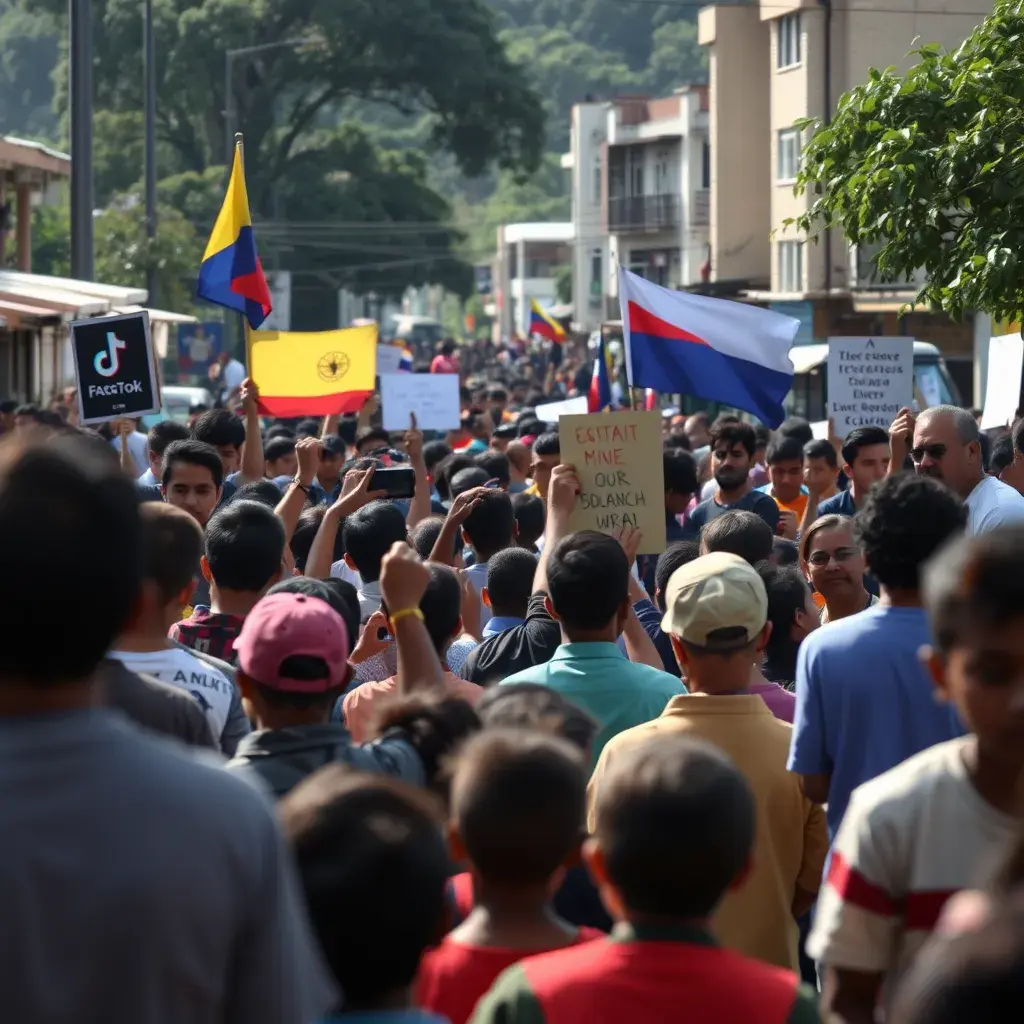
HRW dice que Facebook y TikTok ayudaron a grupos armados a reclutar niños en Colombia.
Human Rights Watch dice que Facebook y TikTok han ayudado a grupos armados en Colombia a reclutar niños, con contenido en las plataformas que contribuye a lo que un informe describió como un aumento drástico en el reclutamiento de niños en los últimos años. La…
You're going to have to put in an eyeroll react if you're going to keep flooding my algorithm with this nonsense rage bait. Today I had "Ask a TERF", Tim fucking Pool, and 3 different "crunchy moms" groups with questions about whether they should vaccinate their sick kids.