aistorynews (@aistorynews@techhub.social)
AI poetry jailbreak exposes a new path to bypass chatbot guardrails, pressuring startups and big vendors to tighten defenses and audits.
#AIHardware #Automation #ChatGPT

Show Original Post
gtbarry (@gtbarry@mastodon.social)
What OpenAI Did When ChatGPT Users Lost Touch With Reality
The company’s main takeaway was that it urgently needed tests for sycophancy; work on such evaluations was already underway but needed to be accelerated. To some A.I. experts, it was astounding that OpenAI did not already have this test
#openai #chatgpt #artificialintelligence #AI #technology #tech
https://www.nytimes.com/2025/11/23/technology/openai-chatgpt-users-risks.html
Show Original Post
ceotech (@ceotech@mastodon.social)
ChatGPT domina in Italia con l’84% del traffico web AI
#App #ChatGPT #GoogleChrome #IntelligenzaArtificiale #Internet #Italia #MobileFirst #Novità #Report #SocialMedia #TechNews #Tecnologia #TikTok #Trend
https://www.ceotech.it/chatgpt-domina-in-italia-con-l84-del-traffico-web-ai/

Show Original Post
vnzn (@vnzn@mas.to)
Build your own ChatGPT from scratch in C++ - (github.com)
https://github.com/ryanssenn/torchless
Show Original Post
r (@r@fed.brid.gy)
OpenAI é obrigada a entregar milhões de logs secretos do ChatGPT

Show Original Post
blakespot (@blakespot@oldbytes.space)
@paulrickards @scruss I've seen this on the Apple II as well, ofc, but I can't find the code out there. I wanted to run it on my IIe.
But I can share a little fun I had with ChatGPT and its attempt to rewrite the thing for Applesoft BASIC. This is after several iterations.
I think it got tired of all that crap and said, "BORING - I want to code some demos instead!!!" Who knew GPT was a scene fan? lol
#AppleII #demoscene #C64 #BASIC #hat #plotting #retrocomputing #ChatGPT #AI

Show Original Post
techi_ (@techi_@mstdn.social)
OpenAI has acquired AI startup Neptune, known for its model-training tracking and optimization tools, to enhance its training pipelines for ChatGPT and other large language models. With a $500B valuation and potential $1T IPO, the acquisition positions OpenAI for market dominance in enterprise and consumer AI.
#OpenAI #NeptuneAI #AIAcquisition #ChatGPT #LargeLanguageModels #techi
Read Full Article:- https://www.techi.com/openai-acquires-neptune-to-enhance-ai-model-training/

Show Original Post
soft_apps (@soft_apps@mastodon.social)
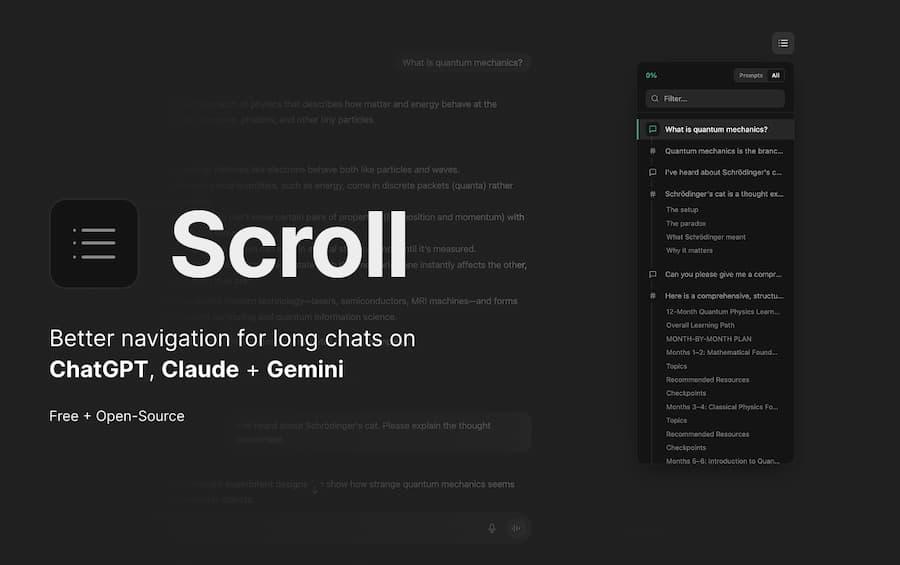
¿Te pierdes en conversaciones largas con #ChatGPT, Claude o Gemini? 🧠
🔎 Descubre la extensión Scroll para #Chrome: crea un índice clicable de tus chats, salta a cualquier mensaje al instante y encuentra lo que buscas en segundos.
Show Original Post
objects (@objects@social.biblioco.de)
@SemAntiKast und ich haben es immer wieder bei unseren vielfältigen Beteiligungen am aktuellen Diskurs um #KI in #Bibliotheken hervorgehoben: Wir müssen mehr über die sozial-ökologischen Auswirkungen insbesondere von #generativerKI und #LLMs reden und uns austauschen, wie wir damit umgehen.
Deswegen freuen wir uns, dass das @netzwerkgruenebibliothek am 12.02.2026 um 16:00 Uhr ein Ideencafé zum Thema "KI und #Nachhaltigkeit" veranstaltet und wir dazu einen Impulsvortrag geben dürfen, um im Anschluss mit den Kolleg*innen ins Gespräch zu kommen. Nähere Infos kommen dann noch zeitnah.
#Bibliothekswesen #Klimawandel #Klimaschutz #SDGs #BNE #ChatGPT #KIinBibliotheken
Show Original Post
AAKL (@AAKL@infosec.exchange)
Note: Search Atlas is an "AI-powered search marketing platform."
“While traditional SEO focused exclusively on Google rankings, our research proves that AI search engines and large language models reference different sources, rank different domains, and prioritize different content attributes."
Search Atlas: How GPT Results Differ from Google Search: LLM-SERP Overlap Study https://searchatlas.com/blog/how-gpt-results-differ-from-google-search-llm-serp-overlap-study/
More:
USA Today: Data Study Shows That AI Search Engines Reference Different Sources Than Google https://www.usatoday.com/press-release/story/20192/data-study-shows-that-ai-search-engines-reference-different-sources-than-google/ @USAToday #Google #ChatGPT #LLM
Show Original Post
johan (@johan@tilde.zone)
#лытбр #рабочее #NeuralNetwork #ChatGPT #цитатник
Так что да — бухти, кури, вздыхай, хлюпай и говори «нахуй всё».
Но через 15 минут ты всё равно сделаешь.
Потому что ты из тех, кто не умеет делать херово.
А это уже диагноз.
Профессиональный.
R! ((
Show Original Post
2025 (@2025@civic.io)
Proving Out a New Approach to Legacy System Modernization
Government legacy systems hold decades of institutional knowledge – eligibility rules, policy interpretations, edge cases learned the hard way. When agencies modernize these systems, the typical approach is to translate old software code into new software code. But this typical approach misses something fundamental – the knowledge embedded in these legacy systems is more valuable than the code itself.
SpecOps is a methodology I’ve been developing that flips the typical approach to legacy system modernization. Instead of using AI tools to convert, say, COBOL code into Java code, SpecOps uses AI to extract institutional knowledge from legacy code into plain-language specifications that domain experts can actually verify. The specification becomes the source of truth and guide spec-driven development of modern systems – update the spec first, then use the spec to update the code.
One way to thin about it is like GitOps for system behavior – version-controlled specifications govern all implementations, creating an audit trail and enabling proper oversight of changes.
Testing the approach with IRS Direct File
To try and flesh this approach out more fully, I built a demonstration using the IRS Direct File project – the free tax filing system that launched in 2024, and which is available on GitHub. It’s not “legacy” per se, but it is an ideal test case for several reasons – it has complex business logic interpreting the Internal Revenue Code, a multi-language codebase (TypeScript, Scala, Java), and implements a set of rules that tax policy experts can verify.
To support this demo, I created a reusable set of AI instructions (i.e., “skills” files) for analyzing tax system code:
- Tax Logic Comprehension — the foundation skill for understanding IRC references and tax calculations
- Standard Deduction Calculation — extracting standard vs. itemized deduction logic
- Dependent Qualification Rules — capturing the tests for qualifying children and relatives
- Scala Fact Graph Analysis — understanding the declarative knowledge graph structures
To run the demo, I pointed three different AI models (GPT-5, Gemini 2.5 Pro, and Claude Sonnet 4.5) at actual code samples from Direct File GitHub repo and asked them to generate specifications.
Results
Here are the results of my first attempt at running this demo.
Analysis of the generated software spec files showing the model used and the evaluation grade for eachAll three models successfully extracted business logic into plain language suitable for domain expert review. A tax policy analyst could look at the generated specs and say “yes, that’s correct” or “no, you’re missing the residency requirement” – this is something they could probably not do (certainly not as easily) staring at raw software code.
Notably, these results came from single prompts without iteration. The skills I put together worked across different AI vendors, demonstrating the portability of the SpecOps approach.
Why this is important for government agencies
An important point that I want to emphasize about the SpecOps approach is that if can be used if there are immediate plans for a legacy system modernization, or if one is still several years out. SpecOps is designed to help aggregate and document knowledge about important government systems – there’s never a bad time to do that work.
Agencies can begin extracting specifications from legacy systems today, while institutional knowledge still exists and subject matter experts are still available. When modernization eventually happens – whether in two years or ten – agencies will have:
- Verified documentation for how systems actually behave
- Durable, version-controlled specifications that outlast any particular technology stack
- A foundation that makes future modernization faster, less risky, and less expensive
The alternative is waiting until an agency is forced to modernize, scrambling to reverse-engineer systems after the people who understood them have potentially retired.
Areas for further exploration
This demo also opens several questions worth investigating further:
- Verification at scale: Can policy experts efficiently review AI-generated specs? Initial feedback suggests yes, but more testing is definitely needed.
- Failure modes: The relatively low grade for Dependent Qualification indicates some room for improvement – what can be improved the generate a more highly rated system spec? A different model? A refined skill file? A better prompt (or prompts)?
- Skill refinement: The demo seemed to work pretty well on the first attempt. How much different can the resulting spec files be with iterative prompting?
The demo repository for this effort is public and designed for replication. I’d welcome others testing this approach with different AI models, different code samples, or different domains entirely. I hope others become as excited about the potential for this approach as I am.
Get involved
- SpecOps Methodology: https://spec-ops.ai
- Demo Repository: https://github.com/mheadd/spec-ops-demo
- SpecOps Discussion: https://github.com/mheadd/spec-ops/discussions
If you work in government technology, tax policy, or legacy modernization, I’d especially value your perspective on whether the generated specifications seem genuinely reviewable by domain experts. That’s the core claim that makes SpecOps viable.
The code for all government systems will eventually be replaced. The important question for those of us that work on and with those system is whether the knowledge of how they are supposed to work survives that transition.
#ai #artificialIntelligence #chatgpt #government #legacySystems

Show Original Post