mboelen (@mboelen@mastodon.social)
A file server written in #Python that does it all: copyparty
https://github.com/9001/copyparty
Amazing how so many features and development went in one tool. This why I love #FOSS.
The video is brilliant as well: https://youtu.be/15_-hgsX2V0?si=x8RBx_O61crAchfQ
In many home networks this might be a much better option than something like #NextCloud. Just run it on a #Linux system and go.
Show Original Post
GripNews (@GripNews@mastodon.social)
🌘 使用 HomeKit 遠端切換 Steam 使用者
➤ 透過 HomeKit 實現 Steam 帳戶無縫切換的技術指南
✤ https://github.com/rcarmo/homekit-steam-user-switcher
本文介紹了一個名為 `homekit-steam-user-switcher` 的開源專案,它能讓使用者透過 Apple 的 HomeKit 平臺,遠端控制在 Linux 電腦上切換不同的 Steam 使用者帳戶。作者利用 Python 撰寫腳本,模擬成一個 HomeKit 電視配件,每個輸入頻道代表一個 Steam 使用者。透過在 HomeKit 中選擇不同的頻道,就能自動更新 Steam 的自動登入設定,而關閉「電視」則會重新啟動 Steam。此專案解決了在無頭(headless)機器上頻繁切換 Steam 使用者帳戶的便利性問題。
+ 這個想法太棒了!再也不用每次都手動去 Steam 設定裡改了。
+ 很好奇它的底層原理,是怎麼跟 Steam 互動的?
#HomeKit #Steam #Python #Linux #自動化
Show Original Post
aoristdual (@aoristdual@floss.social)
I just launched the open beta of Stave (https://stave.app/), a free-forever and open source app I've built for #rollerderby officiating signups and staffing. It's build with #Django and #Python.
Stave offers a form builder, cross-league calendaring, a smart crew builder, and email templates. Training videos on the homepage!
Show Original Post
brentlineberry (@brentlineberry@mastodon.online)
I deployed some changes to the site today:
- Removed Twitter integration
- Fixed a bug preventing Bookmark posts from syndicating to mastodon
- Fixed an RSS feed warning about photo posts having a relative URL
https://orangegnome.com/posts/3636/changelog-removed-twitter-integration-bugfixes
#Django #Twitter #Indieweb #Python #Changelog
Show Original Post
maphew (@maphew@vmst.io)
I love this #uv #python idea: uv as a self-contained tool wrapper - https://github.com/astral-sh/uv/issues/10465
> With the above translations in place, I could distribute uv as, say, cbdep (a Python tool I maintain), and the following things would Just Work(tm) on any platform:
```
cbdep --version # normal invocation of the cbdep command
cbdep self upgrade # get the latest version of cbdep
cbdep self uninstall # remove all artifacts
```
yes please uviverse!
Show Original Post
leanpub (@leanpub@mastodon.social)
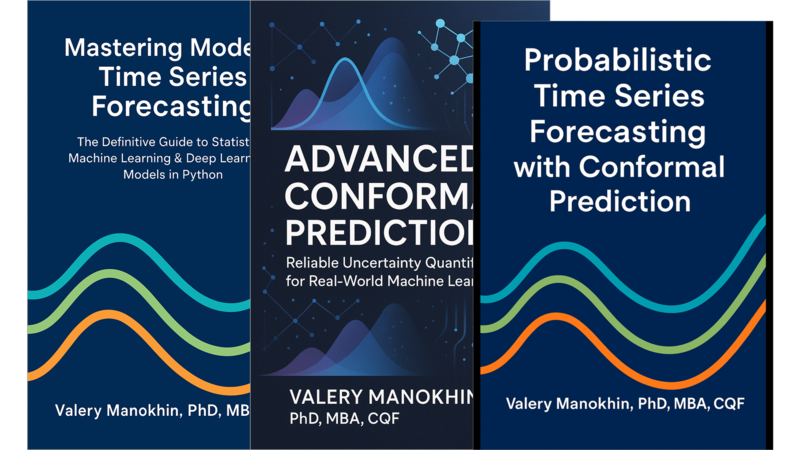
Mastering Modern Time Series Forecasting + Advanced Conformal Prediction + Probabilistic Forecasting with Conformal Prediction in Python https://leanpub.com/b/forecasting_conformalprediction_probabilistic_forecasting by Valery Manokhin is the featured bundle of ebooks 📚 on the Leanpub homepage! https://leanpub.com #ComputerScience #MachineLearning #Mathematics #Python #DataScience #DeepLearning #Education #books #ebooks
Show Original Post
mgorny (@mgorny@social.treehouse.systems)
New on #Quansight PBC blog: Python Wheels: from Tags to Variants
https://labs.quansight.org/blog/python-wheels-from-tags-to-variants
"""
Many #Python distributions are uniform across different Python versions and platforms. For these distributions, it is sufficient to publish a single wheel that can be installed everywhere. However, some packages are more complex than that; they include compiled Python extensions or binaries. In order to robustly deploy these software on different platforms, you need to publish multiple binary packages, and the installers need to select the one that fits the platform used best.
For a long time, Python wheels made do with a relatively simple mechanism to describe the needed variance: Platform compatibility tags. These tags identified different Python implementations and versions, operating systems, and CPU architectures. Over time, they were extended to facilitate new use cases. To list a couple: PEP 513 added manylinux tags to standardize the core library dependencies on GNU/Linux systems, and PEP 656 added musllinux tags to facilitate Linux systems with musl libc.
However, not all new use cases can be handled effectively within the framework of tags. To list a few:
• The advent of GPU-backed computing made distinguishing different acceleration frameworks such as NVIDIA CUDA or AMD ROCm important.
• As the compatibility with older CPUs became less desirable, many distributions have set baselines for their binary packages to x86-64-v2 microarchitecture level, and Python packages need to be able to express the same requirement.
• Numerical libraries support different BLAS/LAPACK, MPI, OpenMP providers, and wish to enable the users to choose the build matching their desired provider.
While tags could technically be bent to facilitate all these use cases, they would grow quite baroque, and, critically, every change to tags needs to be implemented in all installers and package-related tooling separately, making the adoption difficult.
Facing these limitations, software vendors have employed different solutions to work around the lack of an appropriate mechanism. Eventually, the #WheelNext initiative took up the challenge to design a more robust solution.
"""
Show Original Post
hugovk (@hugovk@mastodon.social)
Just released: Python 3.14.0 release candidate 2! 🚀🐍
🪄 This was planned for 2025-08-26, but we fixed a bug that required bumping the magic number stored in bytecode (.pyc) files
🪄 This means .pyc files created for rc1 will be recompiled for rc2
🪄 The ABI isn’t changing
🪄 Wheels built for rc1 should be fine for rc2, rc3 and 3.14.x
🤖 Did I mention Android binaries?
🏆 Bonus: We also released an early Python 3.13.7!
https://discuss.python.org/t/python-3-14-0rc2-and-3-13-7-are-go/102403
#Python #CPython #Python314 #Python313 #release
Show Original Post
mgorny (@mgorny@pol.social)
Dziś ktoś pytał w temacie walki z ostrzeżeniami o "przestarzałej" funkcjonalności w #setuptools (w #Gentoo zbieramy je i wypisujemy ponownie, więc ludzie faktycznie mogą je zauważyć). Myślę, że moją najlepszą podpowiedzią było: użyj innego systemu budowania.
Show Original Post
mgorny (@mgorny@social.treehouse.systems)
Someone asked about fixing #setuptools deprecation warnings today (#Gentoo collects and reprints them, so people actually notice). I think my best hint is: use another build system.
Show Original Post
yossarian (@yossarian@infosec.exchange)
super excited to have this land: you can now pull project status markers (PEP 792) from PyPI's APIs!
https://blog.pypi.org/posts/2025-08-14-project-status-markers/
Show Original Post
hackernoon (@hackernoon@mas.to)
My attempt to noodle around. https://hackernoon.com/inside-the-bonkers-diy-project-to-corral-every-gadget-rumor-on-earth #python
Show Original Post