kensuke_om (@kensuke_om@mstdn.jp)
投資で破産しないための数学:ケリー基準を理解する #Python - Qiita https://qiita.com/tikeda123/items/3f4dd42c8f57333deeaf
Show Original Post
jrovu (@jrovu@mastodon.social)
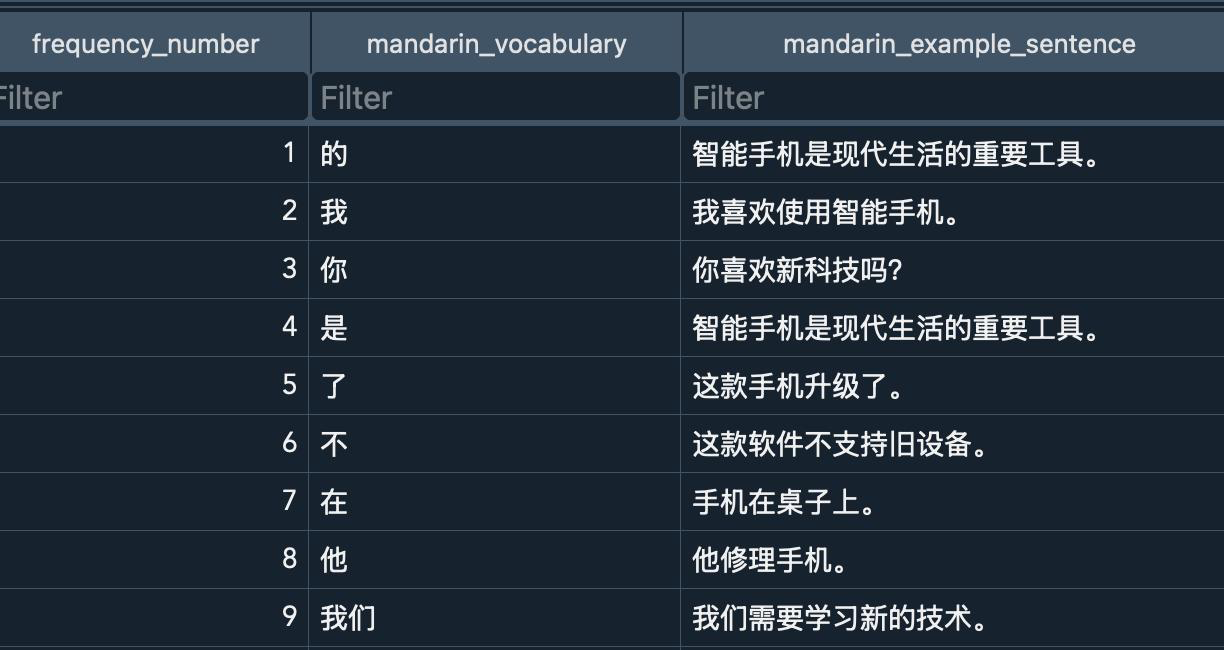
Project update: LingoFreq - language learning tool
Goal: Create voice audio files of high-frequency Mandarin words & example sentences
Loads high-frequency #Mandarin #Chinese words from HSK CSV file into an #SQLite #database, using #Python. Then we loop over all the Mandarin words, and call to OpenAI ChatGPT to create simple example sentences. Next, we'll use ElevenLabs #VoiceSynthesis text-to-speech to vocalize the example sentences as audio files.
Code: https://codeberg.org/jro/LingoFreq-app/src/branch/main/apps/generate_example_sentences.py
Show Original Post
cr0n0s (@cr0n0s@social.tchncs.de)
#Python: The Documentary | An origin story :python:
🔗https://www.youtube.com/watch?v=GfH4QL4VqJ0
Enjoy!
Show Original Post
ChickenPwny (@ChickenPwny@infosec.exchange)
refactoring the code and the relations between the classes. we can see the chaos become ordered.
left ordered, right chaotic
#programming #fun #hobbies #python

Show Original Post
diazona (@diazona@techhub.social)
@mark @glyph @wildrikku Part of the point I was making earlier, though, is that with inline script metadata, #Python *does* now have self-contained single-file programs, or about as close as you can get to it in an interpreted language (which necessarily requires getting some sort of interpreter on your system). With the caveat that it's somewhat new technology so there are some kinks being worked out.
Show Original Post
yossarian (@yossarian@infosec.exchange)
TIL: Safari has built-in WebDriver support
https://yossarian.net/til/post/safari-has-built-in-webdriver-support/
Show Original Post
diazona (@diazona@techhub.social)
@wildrikku @mark Wait there's *another* requests library? 😵💫 I'm talking about this one: https://pypi.org/project/requests/
I'd add that I think one of the emerging strengths of Python is how easy it makes it to use dependencies, especially with inline script metadata (https://packaging.python.org/en/latest/specifications/inline-script-metadata/). So the reasons to avoid dependencies are getting less and less relevant, and people who dogmatically insist on avoiding dependencies without a good reason - not saying that's you, but those people are out there - appear increasingly out of touch with modern best practices.
That being said, I still think it'd be a big improvement if the Python stdlib included better-designed URL handling modules, but realistically, I don't think that's going to happen. It's just that, because of the rich third-party library ecosystem, that's not as big of a problem as it would otherwise be.
Show Original Post
emilyselect (@emilyselect@mastodon.social)
R言語入門6~Googleコラボラトリで学ぶ if文と再起呼び出し
#Python #r入門 #r言語 #データサイエンス #どっちがいい #プログラミング #ベクトル #情報入試 #早大 #統計 #R言語基礎・入門 #R言語基礎・入門 #Python #r入門 #r言語 #データサイエンス #どっちがいい #プログラミング #ベクトル #情報入試 #早大 #統計

Show Original Post
pythonbrasil (@pythonbrasil@pynews.com.br)
Tutorial
Começando com FastAPI: construa sua primeira API em Python - Felipe de Morais
Aprenda a criar sua primeira API com FastAPI! Neste tutorial para iniciantes, você vai construir uma API REST do zero usando Python de forma prática e descomplicada.
#python #bolhadev #pythonbrasil #pybr2025

Show Original Post
leanpub (@leanpub@mastodon.social)
7 Course-Bundle: Shut Up and Code Python + PyCharm + Coding Interview + Machine Learning + One-Liners + Regex + Lambdas http://leanpub.com/set/leanpub/7courses by Christian Mayer, Lukas Rieger, and Shubham Sayon is the featured Track on the Leanpub homepage! https://leanpub.com #ComputerProgramming #Devops #python #pycharm #programming #career
Show Original Post
objects (@objects@ublog.byme.at)
The real estate developer of the building where I am going to live have a website where you can find morning & evening photos of the site for every date since the start of the project.
So I wrote some #Python to download all these photos.

Show Original Post
diazona (@diazona@techhub.social)
@wildrikku To be fair, the URL handling is a particularly poorly structured portion of the #Python standard library. (Partly because the documentation for `HTTPResponse` lives at a very non-obvious place, https://docs.python.org/3/library/http.client.html#httpresponse-objects)
Most people just use external libraries like `requests` or `httpx`, which are much easier to use than the standard library's `urllib`; I would recommend that.
Show Original Post